From weighed silver in Mesopotamia to modern banknotes: money that tells the story of Baghdad, sovereignty and trust.
In 2003, two notes bearing the same currency name no longer had the same value. One would exchange at par; the other for 150 new dinars. Understanding how these two paper histories met takes us far beyond the modern kingdom, to the markets, mints and written records of the two rivers.
01 / IRAQBefore coins: counting, weighing and promising
Long before a king put his portrait on a coin, the people of Mesopotamia recorded debts, deliveries and prices on clay. Between the Tigris and Euphrates, a tablet might preserve a payment in barley or an obligation stated in silver. The British Museum holds a land-purchase record from about 2400–2200 BCE whose payments include barley, wool and oil. Monetary history here begins with accounts and promises as well as precious objects.
The shekel was originally a unit of weight. A debt measured in silver does not establish that round coins changed hands: metal could be weighed, delivery deferred, or settlement arranged by other means. Barley also served in valuation and payment. Scholars debate how extensively silver actually circulated in different periods and settings. Describing this economy as simple barter would be as misleading as projecting modern banking habits onto it.
This opening does not claim a direct descent from a Sumerian tablet to today’s dinar. It highlights something distinctive about the territory of Iraq: people developed ways to measure value, preserve evidence and acknowledge an obligation very early. Struck coins would enter an already sophisticated world of exchange.
British Museum · Money Gallery · Marvin A. Powell · Money in Mesopotamia (1996)
02 / IRAQBaghdad and the language of coins
Successive empires brought different monetary worlds to the region. Hellenistic conquest, followed by Parthian and Sasanian rule, produced coinages whose portraits and religious symbols expressed changing sovereignties. After the Arab conquests of the seventh century, inherited forms remained in use before Arabic inscriptions became central to coin design.
The vocabulary travelled too. Dinar has a history reaching back to the Latin denarius; dirham is related to the Greek drachma. Names crossed languages and centuries without retaining a fixed weight or value everywhere. A medieval gold dinar is therefore not simply an earlier version of an Iraqi banknote, and no straightforward conversion connects it to modern dinars.
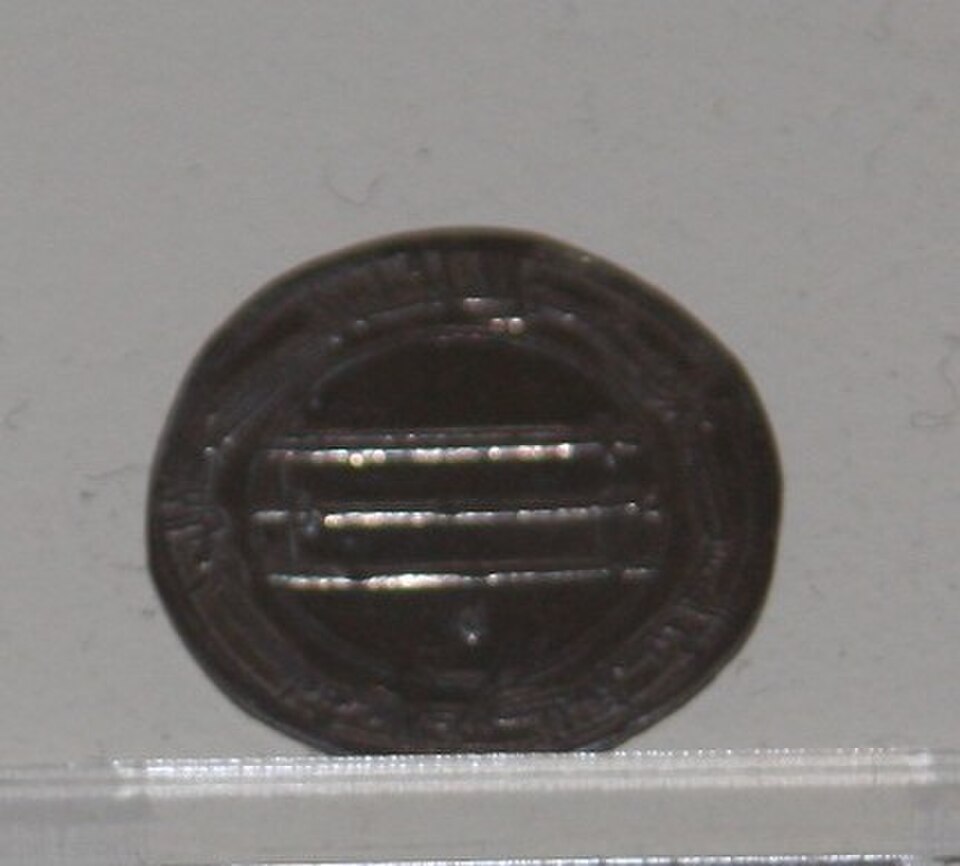
Under the Abbasids, Baghdad appears on coins as Madīnat al-Salām, the City of Peace. The Ashmolean Museum holds a dirham from this mint dated AH 158, corresponding to 774–775 CE. Metal, mint, year and written formulae became identifying features of a coin. These inscriptions now help trace authority and exchange networks extending far beyond the borders of present-day Iraq.

03 / IRAQFrom Ottoman money to the Indian rupee
Under Ottoman rule, Baghdad, Basra and Mosul belonged to a much wider imperial and commercial setting. Ottoman money circulated alongside other currencies. The Metropolitan Museum holds a probably copper coin made in Baghdad and dated 1808–1810: a modest reminder that local minting did not begin with the modern state.
The First World War disrupted this environment. British occupation connected the conquered territories to British India’s monetary network. The Indian rupee became the principal circulating currency. Administration and wartime logistics help explain its presence, alongside the Gulf’s trading links with India. This was the Indian rupee, distinct from the national currencies that would later share the name.
The Kingdom of Iraq, established in 1921 under Faisal I, inherited that arrangement. State-building did not instantly change the habits of cash offices and markets. For several years, political authority was Iraqi while the monetary unit remained the rupee. Creating the dinar would give the kingdom its own notes and coins while retaining a connection to sterling.
The Metropolitan Museum · Baghdad coin, 1808–1810 · Central Bank of Iraq · Institutional history
04 / IRAQ1931–1932: an old name, a new currency
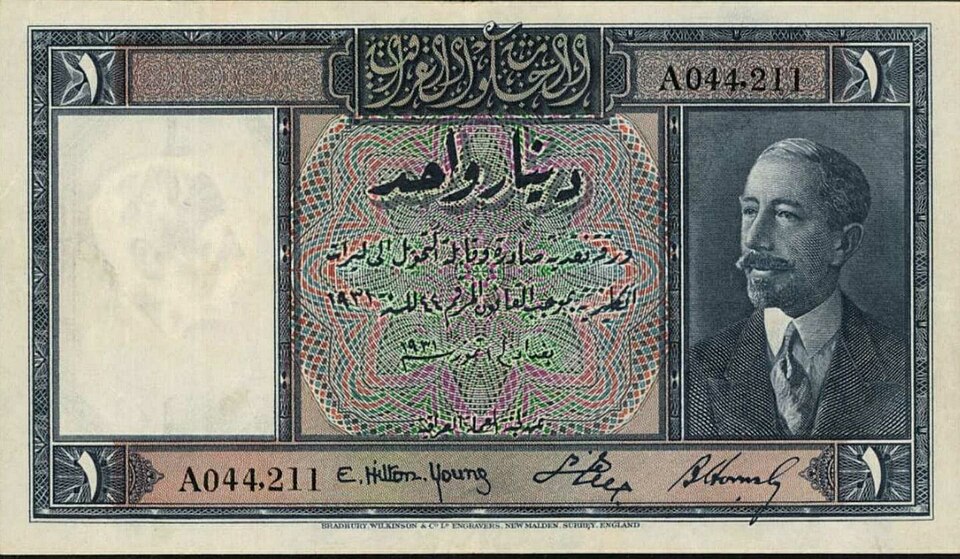
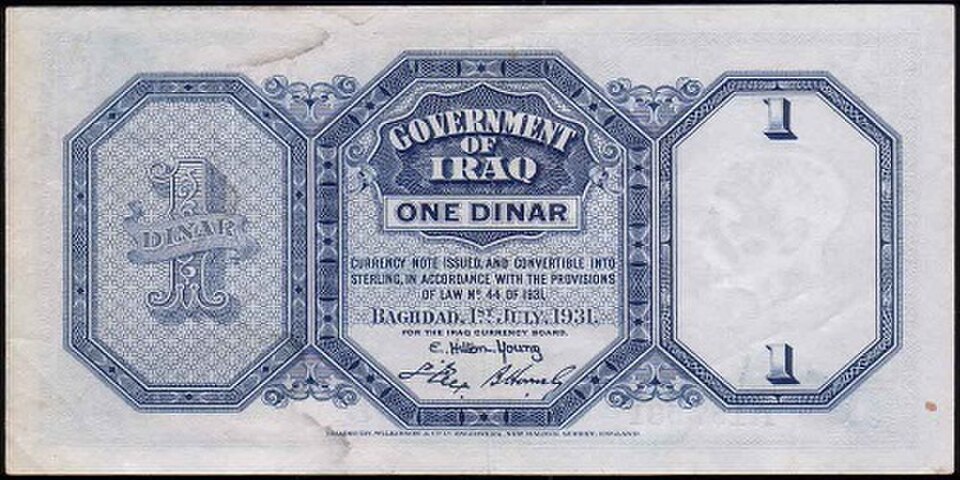
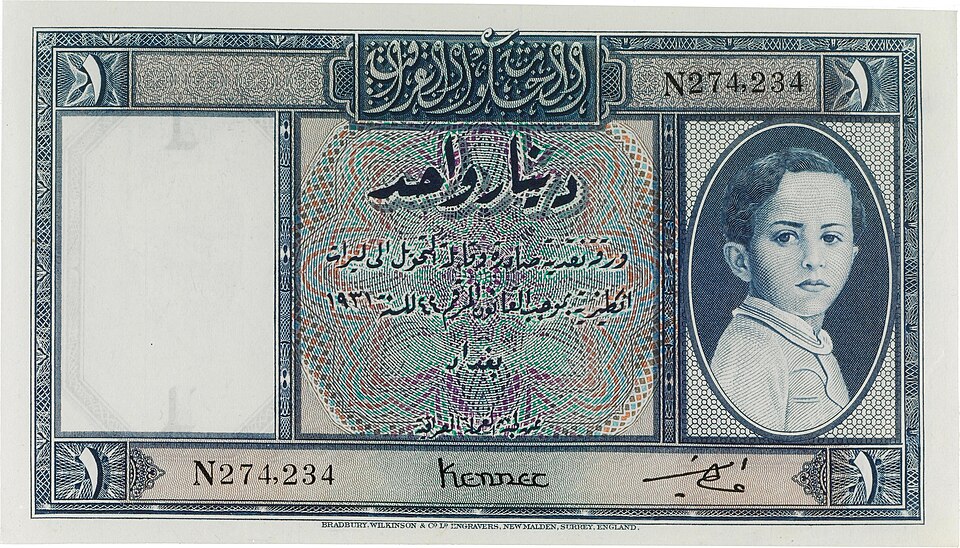
The 1931 law established the Iraqi Currency Board in London to administer note issuance and reserves. The first dinar notes entered circulation in 1932. These dates answer different questions: when was the framework created, and when did the public receive the new money? The reverse of the note shown below explicitly refers to the 1931 law.
The name revived a historical vocabulary familiar to the region. The arrangement itself was modern: one dinar was divided into 1,000 fils, while parity with sterling underpinned the initial system. A quarter dinar represented 250 fils and a half dinar 500. These fractions explain the existence of low-value paper notes that may surprise readers accustomed to banknotes expressed only in whole units.
The note’s political face was national: it carried Faisal I’s portrait. Its financial framework remained connected to London and sterling reserves. The currency thus reflects independence taking shape in stages. The Currency Board was not a central bank conducting discretionary monetary policy: its task centred on reserve-backed issuance and confidence in convertibility.


Central Bank of Iraq · Institutional history · Central Bank of Iraq · Currency formation
05 / IRAQRoyal portraits and everyday coins
Faisal I died in 1933 and was succeeded by Ghazi, then by Faisal II in 1939. Monetary portraits followed the Hashemite dynasty. The image of the very young Faisal II also communicated institutional continuity: the sovereign changed, while the monetary unit and issuing framework remained.
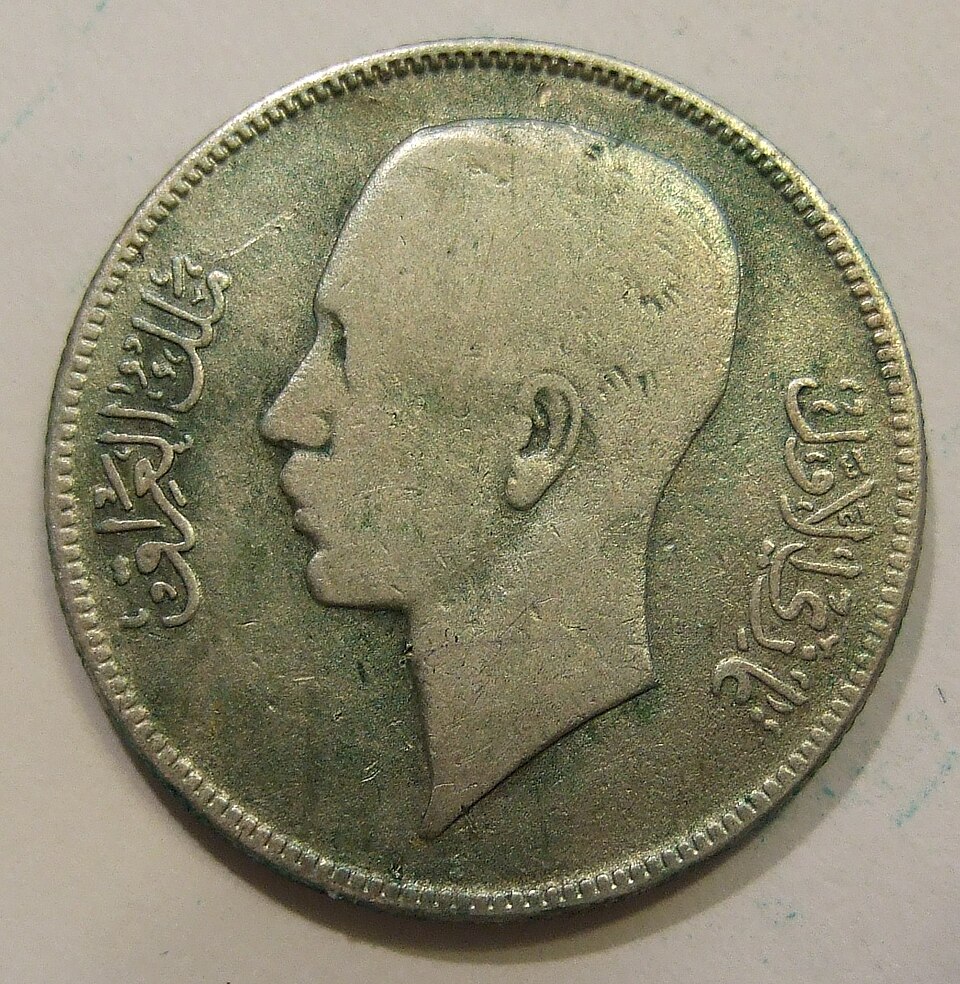
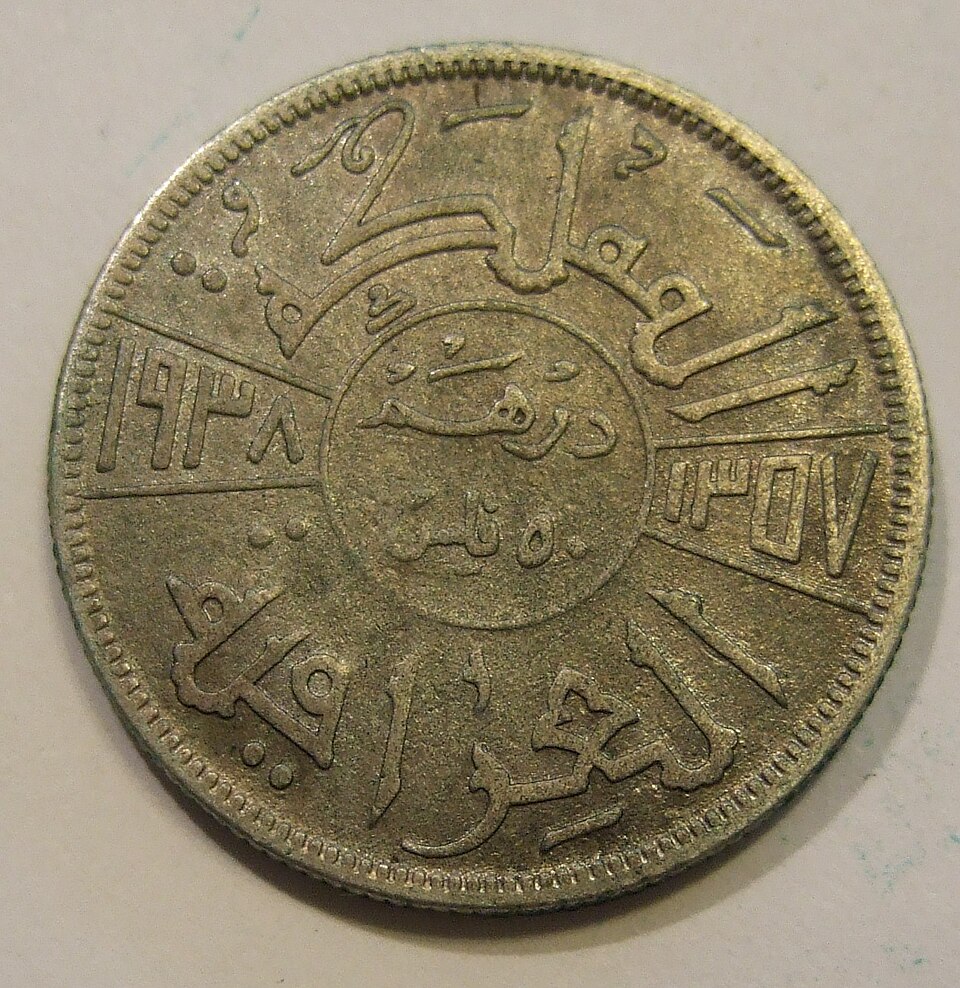
The 1938 fifty-fils coin shows Ghazi in a sharply defined profile. Its other side gives the denomination within Arabic inscriptions and a plant border. According to the photographic record, the coin contains 50% silver. Its significance extends beyond the metal: worth one twentieth of a dinar, it belonged to everyday payments and the making of change. Coins and banknotes record different scales of use.
Mints add another international dimension. The Royal Mint Museum explains that during the Second World War a dot beneath the effigy distinguished Iraqi coins made in London, whereas a star indicated manufacture in India. Pressure on metal supplies also brought changes in alloys and shapes. A tiny mark can therefore document an industrial supply chain and the effects of a distant war on money handled in an Iraqi market.



06 / IRAQ1947–1959: a national bank and a republic
The establishment of the National Bank of Iraq in 1947 marked a further stage. It must be distinguished from the effective transfer of currency responsibilities in 1949, when the Currency Board ceased operating. The name Central Bank of Iraq was adopted under the 1956 law. These are three separate milestones: founding an institution, transferring a function and changing a name.
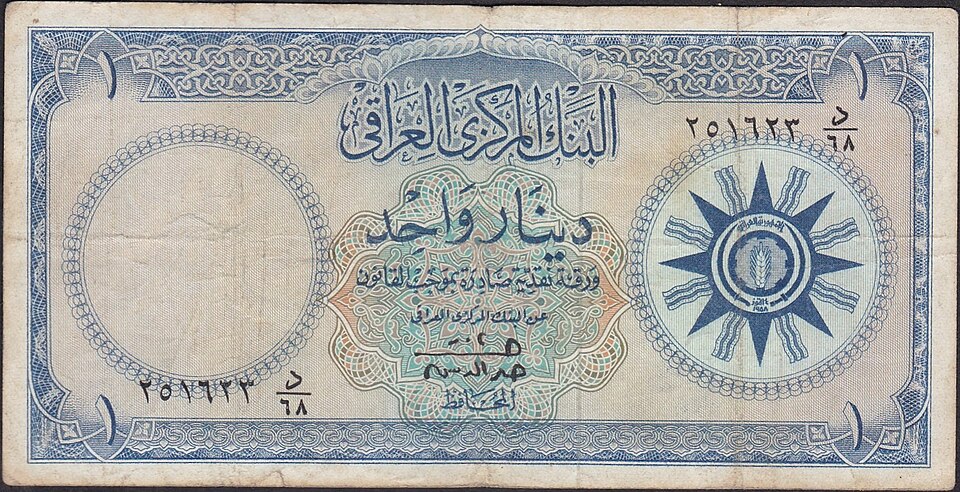
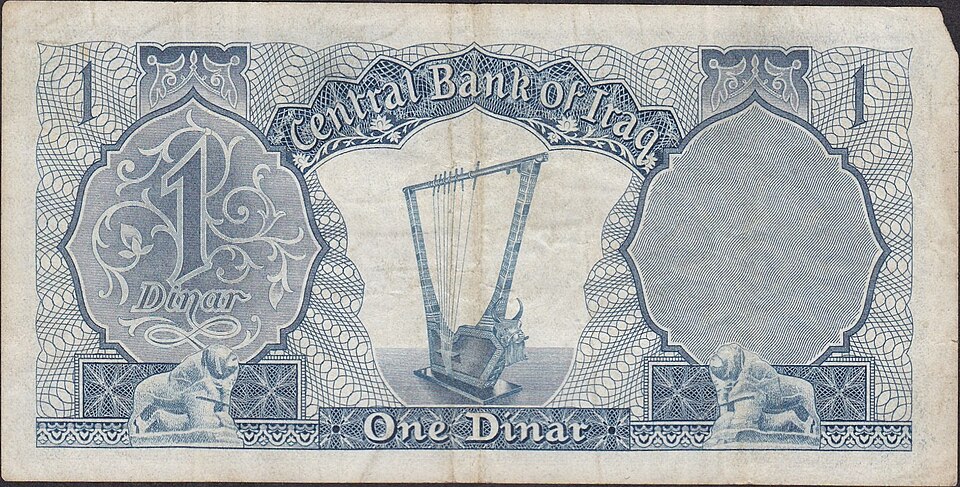
The overthrow of the monarchy on 14 July 1958 then transformed the language of banknotes. A republican emblem replaced the royal portrait. The one-dinar note of the 1959 type shown here makes the change particularly clear: the star and national symbols occupy the sovereign’s former place. On the reverse, port activity presents a country of infrastructure and exchange.
One detail calls for careful reading. The collection record labels the example “1959”, but the signature is Khairuddin Haseeb’s. A type date alone cannot establish the date of every printing. Studying a series also means comparing signatures, serial numbers and variants. A design date, a legal date and a circulation date may all differ.


Central Bank of Iraq · Institutional history · Central Bank of Iraq · Currency formation
07 / IRAQA country in pictures: fields, ports and heritage
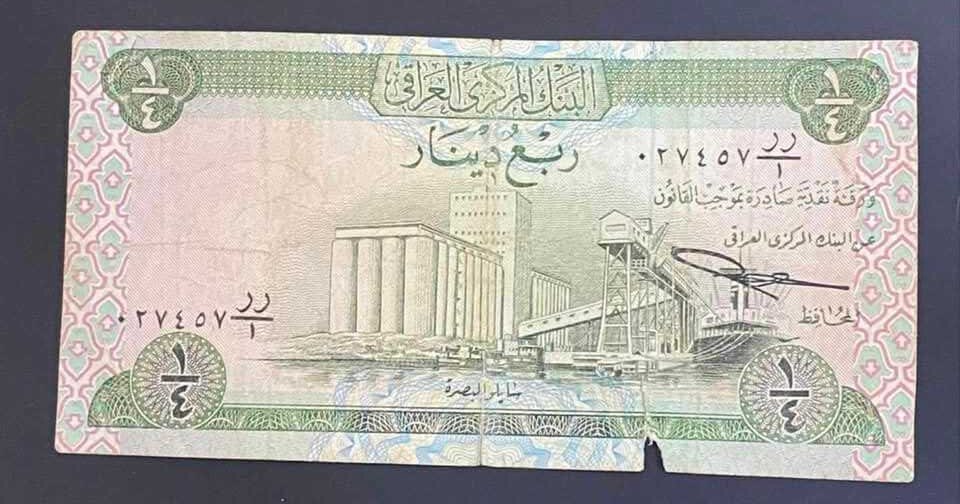
Republican issues involved more than a new emblem. They gave space to monuments, productive activity and infrastructure. The 1973 quarter-dinar note shows grain silos: an image of storage, supply and agricultural organisation. Such a scene can be as revealing as a portrait, selecting the aspects of state action and national life that people see on their money.
The illustrated example is identified as an RR-prefix replacement note. In banknote manufacture, notes rejected during inspection may be replaced by examples belonging to a replacement numbering sequence. This production practice does not create a separate currency or denomination. It helps explain why an apparently minor detail can attract collectors’ attention.
The Central Bank’s account names the British firm De La Rue and a Soviet printer among the producers of earlier internationally manufactured issues. Production circumstances vary between series. A country name informally associated with a banknote should never substitute for identifying its actual printer. This distinction becomes especially important in the story of the “Swiss dinar”.

08 / IRAQWars and sanctions: multiplying paper
The Iran–Iraq War of 1980–1988, the invasion of Kuwait in 1990, the 1991 Gulf War and sanctions brought profound disruption. For money, the issue extended beyond banknote design to public revenue, imports, production and the financing of expenditure. Expanding note issuance accompanied a severe loss of purchasing power.
Restricted access to overseas security printing encouraged the production of lower-quality notes. The Central Bank names local production at Dar al-Nahrain. Notes bearing Saddam Hussein became characteristic of the period, although his portrait alone does not precisely date an individual example. Paper and security features matter: a banknote needs to remain recognisable, withstand handling and resist counterfeiting.
Inflation changes the scale of daily life for households and traders. As prices rise, a small denomination no longer performs the same practical function; more paper is needed to settle a purchase. The printed figure and purchasing power diverge. Historic official exchange rates may no longer describe the terms on which residents can actually obtain foreign currency or goods.
Central Bank of Iraq · Institutional history · Mervyn King · The Institutions of Monetary Policy (2004), pp. 12–16
09 / IRAQThe “Swiss dinar”: money without new issuance
In Iraqi Kurdistan, older notes continued circulating while another set of banknotes developed in Baghdad-controlled areas. The withdrawal of the twenty-five-dinar note in 1993 became a decisive moment: people in the North could not participate in the exchange on the same terms. The older money continued to function within an economy that had become separate in practice.
“Swiss dinar” was the name given to these earlier issues. It did not mean Swiss francs, nor did the Swiss National Bank guarantee them. In his 2004 study, Mervyn King connected the nickname to printing plates manufactured in Switzerland while identifying De La Rue as the printer. That is an attributed explanation, not grounds for describing every older series as Swiss-printed.
The result was striking: without replenishment from an active issuer, the notes remained acceptable. Their supply was limited while newer notes multiplied elsewhere. Scarcity was not the whole explanation, however. Shared usage and expectations about the political future also supported their value. The two dinars developed different purchasing powers and dollar exchange rates. A shared name no longer meant the same monetary reality.
Mervyn King · The Institutions of Monetary Policy (2004), pp. 12–16
10 / IRAQ2003–2004: reuniting cash and payments
After the fall of the regime in 2003, a currency reform aimed to provide money usable throughout the country. Announced on 7 July, the exchange ran from 15 October 2003 to 15 January 2004. These dates correct a common shortcut: replacement was not completed “at the beginning of 2003”.
Two conversion rules applied. One dinar in the circulating “Saddam” issues exchanged for one new dinar; one “Swiss” dinar exchanged for 150 new dinars. This was not a uniform deletion of zeros. It brought together systems whose values had diverged. As a purely arithmetic illustration, ten “Swiss” dinars became 1,500 new dinars, while ten dinars from the other set became ten new dinars.
The task was physical as well as monetary: transporting and distributing new notes, collecting and destroying old ones, and checking authenticity. The IMF emphasised the usefulness of a wider range of denominations and stronger protection against counterfeiting. Its 2004 account records six denominations at launch, whereas later retrospectives group together an expanded range. A catalogue must identify which stage it describes.
Heritage and landscapes took prominent places on the new money. Reform could not substitute for rebuilding institutions, but it restored a shared language for cash payments across the country.
IMF · New Iraqi banknotes, 7 July 2003 · IMF · Iraq, Country Report 04/325 · Mervyn King · The Institutions of Monetary Policy (2004), pp. 12–16
11 / IRAQReading the notes: a pocket cultural atlas
The post-reform series brings together science, monuments and regional landscapes. The 250-dinar note pairs an astrolabe with Samarra’s spiral minaret; the 500 dinars combines the Dukan Dam with a winged bull. Ancient heritage, learned traditions and modern infrastructure share the same national narrative.
The 5,000-dinar note brings together the Gali Ali Beg waterfall and al-Ukhaidir fortress. The reverse of the 10,000 dinars shows Mosul’s celebrated al-Hadba minaret, while the front changed between editions: Ibn al-Haytham in the original series, the Freedom Monument in later versions described by the Central Bank. The imagery of one issue should not be assigned to every date.
The 25,000-dinar note includes a female agricultural figure and Hammurabi. The reference to the stele does not make the Babylonian king the inventor of the dinar: it connects Iraq to a history of law and heritage. Agricultural details also change in revised editions. Reading a banknote means inspecting both sides and identifying the edition.
In 2018, the 1,000-dinar note replaced its Islamic-dinar motif with an emblem associated with the World Heritage inscription of the marshes and sites of southern Iraq. Baghdad’s al-Mustansiriya school remained on the reverse. This specific change shows how a banknote can incorporate a recent recognition of heritage without changing the monetary unit.
Central Bank of Iraq · Banknotes and designs · Central Bank of Iraq · Statement, 7 October 2018
12 / IRAQFils, larger notes and continuity
The dinar retains its division into one thousand fils, but an accounting subdivision need not have a physical place in people’s pockets. Inflation shifted payments towards amounts that made old small coins of little practical use. Fils in an older catalogue document a different level of prices and a different circulating landscape.
Two events in 2015 illustrate adjustments to physical cash: the fifty-dinar note was withdrawn on 1 May, and a 50,000-dinar denomination joined the range during the year. One removed a small note that had become inconvenient; the other made it possible to carry a sum in fewer notes. Neither created a new currency. The 50,000-dinar design features a waterwheel and date palms, followed by marshland and river geography.
The distinction matters when telling monetary history. Changing a design, adding a larger denomination, withdrawing a note and replacing a unit are four different operations. Iraqi dinars offer examples of such transformations, but they are not all the same kind of reform. The story lies in the relationship between institutions, physical money and the confidence of its users.
13 / IRAQMilestones without confusion
| Date | Change | Distinction to retain |
|---|---|---|
| Before coinage | Accounts in barley and silver | A weight unit is not a struck coin. |
| Abbasid period | Baghdad’s Madīnat al-Salām mint | Gold dinars and silver dirhams are not the modern currency. |
| 1931 / 1932 | Currency Board / dinar circulation | The law and the issue are separate events. |
| 1947 / 1949 / 1956 | National Bank / transfer of issuance / Central Bank name | Three institutional stages. |
| 1958–1959 | Republic and new imagery | The dinar keeps its name. |
| 1990s | Two monetary systems | The “Swiss” dinar is not a Swiss franc. |
| 2003–2004 | Exchange and reunification | One for one; 150 for one, depending on the old issues. |
| 2015 / 2018 | Denomination and design changes | The unit remains the same. |
From weighed silver to high-denomination paper, these objects preserve overlapping memories of trade, sovereignty, manufacturing skills and landscapes chosen to represent the country. A removed portrait or a reinstated monument can never sum up the lives of the population. Seen together, however, they reveal changes with a precision that figures alone cannot provide.
Sources and credits
Research checked on 15 October 2026. Descriptions of recent notes distinguish editions; they are not a catalogue of every variant.
- British Museum · Money Gallery
- Marvin A. Powell · Money in Mesopotamia (1996)
- Ashmolean Museum · Dirham, Madīnat al-Salām
- The Metropolitan Museum · Baghdad coin, 1808–1810
- Central Bank of Iraq · Institutional history
- Central Bank of Iraq · Currency formation
- Royal Mint Museum · Overseas coinage
- Mervyn King · The Institutions of Monetary Policy (2004), pp. 12–16
- IMF · Iraq, Country Report 04/325
- IMF · New Iraqi banknotes, 7 July 2003
- Central Bank of Iraq · Banknotes and designs
- Central Bank of Iraq · Statement, 7 October 2018
- Wikimedia Commons · Iraqi currency copyright
Each illustration identifies its source and reuse status. The local manifest preserves detailed records. Creative Commons photographs retain their respective licences; historic scans are identified under the public-domain status stated in their records.