A royal portrait, an ancient forum, an irrigation project: Jordan’s earliest dinars already brought several stories together. Understanding them means following money in these lands long before the kingdom, then separating the dates of legislation, manufacture and circulation.
1 July 1950The Jordanian dinar enters circulation
01 / JODPetra: coinage at the caravan crossroads
Long before the Hashemite kingdom, the lands of present-day Jordan formed part of a trading world linking Arabia, Syria and the Mediterranean. Calling an ancient coin “Jordanian” would impose modern borders on a much older landscape. Coins nevertheless offer a remarkable way to trace the rulers and trading networks that shaped these lands.
The Nabataeans give this story one of its earliest recognisable faces. Their capital, Raqmu — Petra — commanded important caravan routes. Incense, spices and other valuable goods travelled through a world in which coins helped people pay, collect revenue and store wealth, alongside other forms of exchange. Nabataean silver and bronze show a kingdom participating in Hellenistic monetary traditions and developing its own visual language.
A portrait that travelled further than its ruler
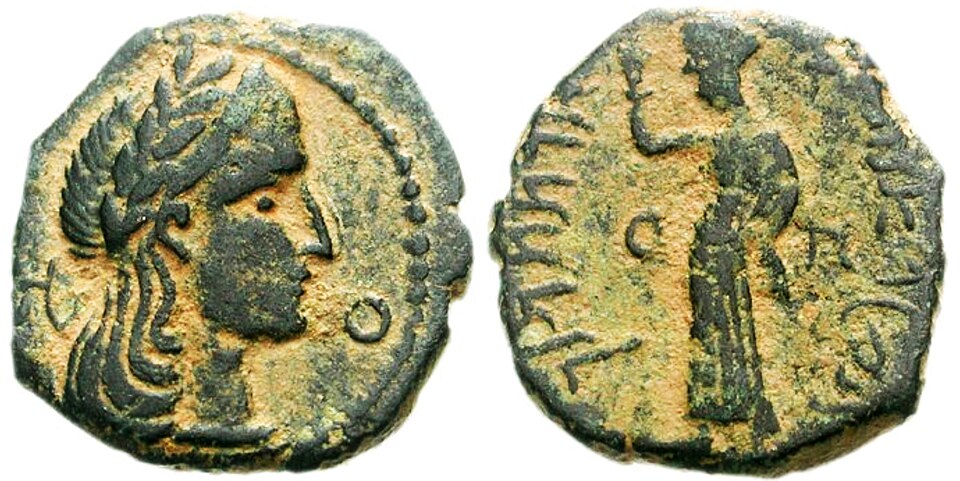
Under Aretas IV, who ruled from 9 BCE to 40 CE, royal images circulated on coinage. Some issues pair the king with a queen; others display a standing figure or crossed cornucopias. Nabataean inscriptions and images turned these tiny surfaces into political messages, making authority visible in everyday transactions. The bronze illustrated here, attributed to 3 BCE, has a portrait and a standing figure: it should not be confused with a different type showing paired royal portraits.
Minting was associated with Petra, while the kingdom’s earlier expansion had also led to issues at Damascus. In 106 CE, incorporation into the Roman province of Arabia ended the royal Nabataean coinage. Imperial and provincial issues subsequently connected the region’s towns with a much larger monetary world. This was a change of issuing authority and political setting, rather than the beginning of money itself. [1] [2]

02 / JODEmpires and the name “dinar”
Roman and Byzantine rule brought several monetary layers: gold for large payments and some public obligations, silver in particular periods, and copper or bronze for smaller transactions. A coin discovered in a town was not necessarily made there. Archaeological findspot, mint and area of circulation answer three different questions, a distinction that matters throughout Jordan’s monetary history.
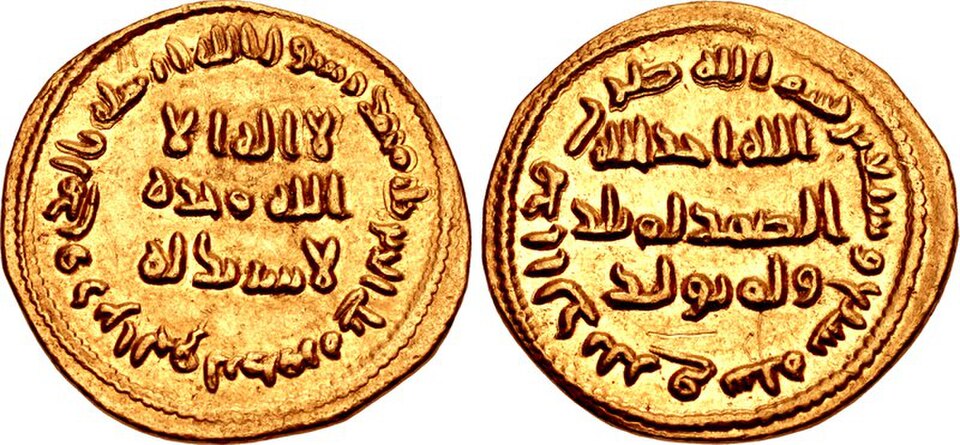
The Arab conquests of the seventh century began a gradual transition. Early Muslim authorities reused and adapted existing monetary forms before developing distinctive issues. Under the Umayyad caliph Abd al-Malik, the late seventh-century gold dinar carried a programme of Arabic inscriptions. The British Museum holds an example dated AH 77, corresponding to 696–697 CE, weighing 4.25 grams. Writing and statements of faith took the place of the imperial image on this reformed type. [3]

A linguistic inheritance, not a thousand-year exchange rate
The name dinar ultimately derives from the Latin denarius [14], transmitted and transformed across languages and monetary systems. Twentieth-century Jordan adopted a prestigious name from Arab and Islamic monetary history. It did not restore the weight or gold convertibility of an Umayyad dinar. The photograph illustrates the regional history of the name, rather than an early issue of the modern Jordanian kingdom.
Later centuries brought successive rulers and coinages. Under Ottoman rule, imperial money interacted with regional trading practices. The reform of 1844 established the Ottoman lira within a system organised around the piastre or kuruş. This vocabulary left a lasting trace: qirsh remains a subdivision name in modern Jordan. Familiar words, however, do not imply unchanged values or uninterrupted use of the same coins. [4]
03 / JODThe Palestine pound: a shared currency
The end of the Ottoman Empire and the remaking of the Middle East after the First World War transformed the setting for everyday payments. The Emirate of Transjordan emerged in 1921 under Abdullah. Before a national currency existed, residents used money belonging to a wider regional economy, in which the Egyptian pound had played an important role.
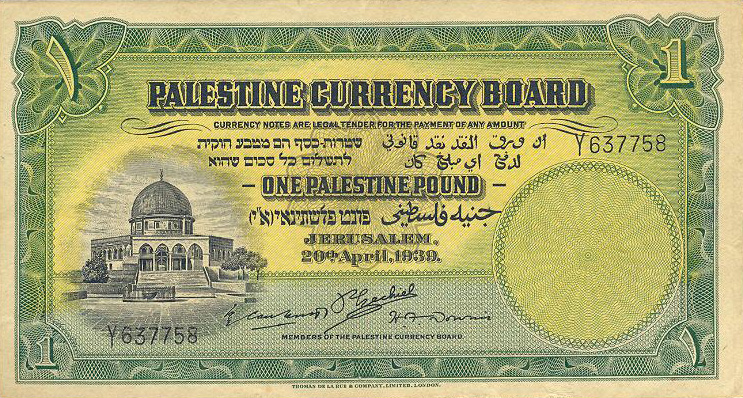
In 1927, the Palestine Currency Board introduced the Palestine pound, which also circulated in Transjordan. Divided into 1,000 mils, it belonged to the sterling monetary framework. The 1939 note shown below combines English, Arabic and Hebrew lettering with an image of the Dome of the Rock. Use in Transjordan did not make it an issue of the emirate: the authority named on the note is the Palestine Currency Board.

This arrangement left two legacies for the future dinar. One was practical: an accounting unit divided into a thousand smaller parts. The other was institutional: a currency board issuing money against external reserves. Notes could not simply be created to finance any domestic expense; issuance required backing in sterling assets. Local payments were therefore connected to reserves and decisions beyond the country itself.
The kingdom’s independence in 1946 did not immediately replace the money in people’s pockets. A national currency required legislation, an issuing authority, physical stocks and an exchange mechanism. The change from pound to dinar would consequently take place several years after independence, at an equal nominal value. This gap between political independence and monetary replacement is essential to understanding the dates printed on Jordan’s earliest money. [5] [6]
04 / JOD1950: the dinar reaches the public
Currency Law No. 35 of 1949 prepared the change by establishing the Jordan Currency Board as the kingdom’s issuing authority. Initially based in London, the board gave the independent state its own notes while retaining much of the earlier institutional framework.
On 1 July 1950, the Jordanian dinar entered circulation at one dinar for one Palestine pound. This was neither a removal of zeros nor an imposed nominal loss for holders of the old currency. Exchange took place during a transition, and use of the Palestine pound in the kingdom ended on 30 September 1950. The World Bank’s contemporary study of Jordan’s development describes the replacement and its reserve arrangements in detail. [5]

Crown, king and landscape
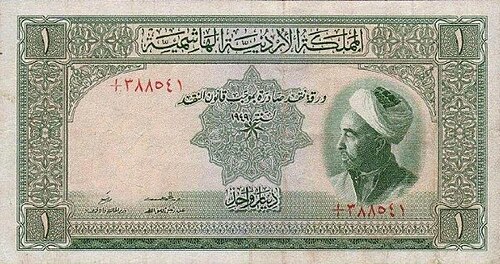
The board’s first issue comprised ½, 1, 5, 10 and 50 dinars. The four whole-dinar denominations carried King Abdullah I’s portrait. The half-dinar instead featured the Wadi al-Arab irrigation project. From the beginning, Jordanian banknotes addressed land and development as well as sovereignty: water management and cultivation had a place alongside the monarchy.
The one-dinar note combines the royal portrait with architectural ornament, while its reverse shows the forum at Jerash. The modern country presents itself as custodian of a much older heritage. In everyday use, such views passed through the hands of people who might never visit the monuments. A banknote became a small, widely shared landscape as well as an instrument of payment.
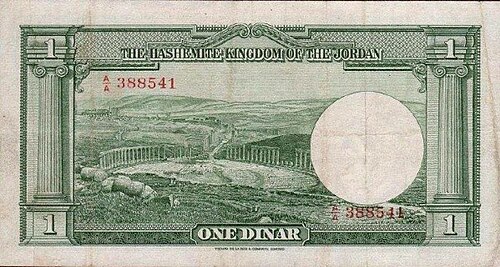

Dating these objects requires care. A collection file labelled “1949” may refer to the law or preparations for issue, without establishing circulation in that year. Coins raise the same question: the Royal Mint Museum explicitly states that the first national coinage was dated 1949 but issued in 1950. The physical object, its legal basis and its release to the public each have a separate chronology. [6] [7]
05 / JODFils, piastres and mints: everyday money
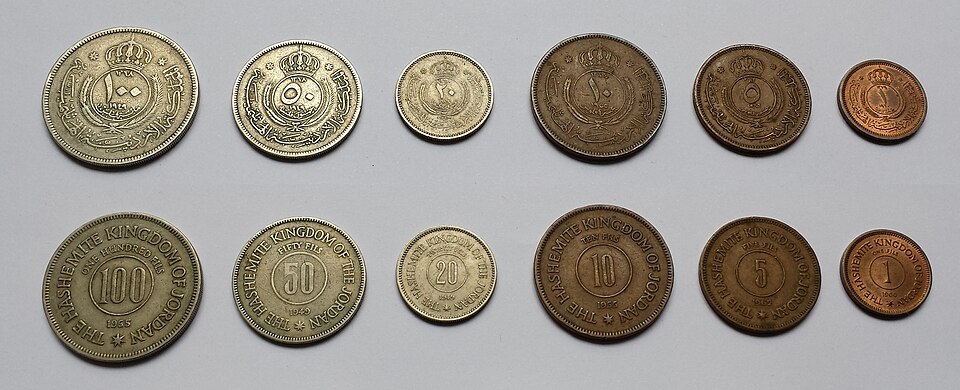
The dinar is divided into 1,000 fils, equivalent to 100 qirsh or piastres. Ten fils make one piastre, 250 fils a quarter-dinar, and 500 fils a half-dinar. Different denomination names can therefore belong to the same system. This also explains prices written to three decimal places: the third decimal represents fils.
The first coin series consisted of 1, 5, 10, 20, 50 and 100 fils, manufactured by Britain’s Royal Mint. A crown and Arabic lettering occupied one side, with English naming the country and value on the other. The smallest denomination preserves an unusual detail. According to the Royal Mint Museum, a misunderstanding about the Arabic singular produced the legend “1 fil” on the initial order, corrected to “1 fils” on later orders. It is a lettering curiosity, rather than evidence of a different subdivision. [7]

History you can feel
In 1968, a portrait of King Hussein replaced the crown on a new series. Later changes in size, portrait, alloy and shape accompanied changing needs for small money. A bimetallic half-dinar appeared in 1997; its seven-lobed outline provided a cue beyond colour alone. Following Abdullah II’s accession in 1999, coins bearing his portrait began appearing in 2000.
In a pocket or across a counter, recognising a coin involves more than reading its numeral. Weight, edge and the contrast between metals help distinguish values. Replacing paper with metal at some lower denominations also changes the useful life of the money and the way change is handled. These material choices form part of monetary history, even when the accounting unit remains unchanged.
Issuing money must also be distinguished from manufacturing it. Jordanian authorities determine denominations, designs and monetary status; a foreign mint may carry out the order. The documented Royal Mint relationship does not turn these coins into British currency, nor establish that every Jordanian coin of every period came from a single workshop. [6]
06 / JOD1959, 1964, 1965: three dates for a central bank
The currency board had established the dinar, but its framework did not meet every need of a state developing its banking system. A central bank could take on broader responsibilities for money, credit, banks and reserves within a more complete national institution.
Legislation in 1959 prepared the creation of the Central Bank of Jordan. The bank began operations on 1 October 1964. On 4 August 1965, it released its first series of notes in its own name, bearing King Hussein’s portrait. Keeping these stages separate avoids treating the law, the operational institution and its banknotes as a single event. [8] [6]
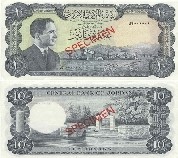
Printed wording is decisive. Hussein’s portrait alone cannot identify the issuer, since he also appeared on Currency Board notes. The issuing authority must be read, followed by signatures, any legal date and security features. A “1959” date associated with a Central Bank note should therefore not automatically be treated as the year that note first reached circulation.
The new institution did not introduce a different dinar. Accounts, prices and contracts continued in the existing unit; the framework of issuance changed. That continuity explains why the dinar’s history contains many new designs and series without a succession of completely new currencies or repeated conversions of the unit itself.
07 / JODBanknotes as circulating heritage
Early banknote generations offer a carefully chosen geography. Jerash recalls the urban heritage of antiquity; Petra gives the national story Nabataean depth; the Dome of the Rock places Jerusalem within a historical and religious horizon. Irrigation and agricultural scenes suggest a country also building its material future. These designs are not administrative maps: an image may express memory, religious ties or cultural aspiration.
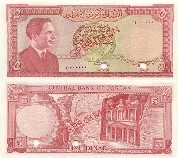
The Treasury at Petra, with a façade particularly suited to engraved interpretation, appears on five-dinar notes. Its familiar nickname does not establish that it was an ancient bank. On paper, the monument becomes an immediately recognisable arrangement of lines, shadows and ornament. The note brings together two forms of art: architecture cut into sandstone and its miniature interpretation in printing.
A new series need not mean a new currency
The Central Bank renewed its banknotes in 1974 and again from 1992. A twenty-dinar denomination joined the second series in 1978. Changes concerned denomination ranges, dimensions, colour, legibility and resistance to counterfeiting. At every stage, the introduction of a series must be distinguished from the release of each individual denomination within it.
The paper half-dinar in older families and the metal half-dinar of later generations illustrate another transition: a value can change its physical form. For historians and collectors, replacing a note with a coin does not in itself amount to devaluation. It reflects choices about production, durability and everyday handling. Comparing the objects reveals developments that a list of exchange rates would entirely miss. [9] [6]
08 / JODOne dinar, several landscapes of memory
The kingdom’s monetary history is intertwined with population displacement and the territorial changes of the twentieth century. Following the 1948 war and Jordan’s annexation of the West Bank in 1950, the dinar also replaced the Palestine pound there. That annexation, which received limited international recognition, cannot be reduced to a technical currency adjustment.
The 1967 war ended Jordanian administration of the West Bank, which came under Israeli occupation. Monetary habits do not necessarily stop when political authority changes. The dinar retained roles in payments, contracts and banking. Later publications by the Palestine Monetary Authority and the IMF document a multicurrency economy using, among other currencies, the Israeli shekel, US dollar and Jordanian dinar. [10]
This history helps explain why banknote landscapes cannot be read simply as statements of borders. It also requires distinctions between sovereignty, legal tender, commercial habit and the unit used in a contract. These categories may overlap, but they are not interchangeable.
Hashemite portraits tell a further story of continuity. Hussein, king from 1952 to 1999, was for many years the most familiar face on Jordanian paper money. More recent families bring several generations of the dynasty together. Each denomination contributes to a wider historical narrative, although the people shown did not all hold the same office or rule the same territory. Reading the portraits as a group is more revealing than treating them as a succession of decorative heads.
09 / JODFrom the 1988–1989 crisis to the 1995 anchor
The survival of the name dinar does not mean its external value remained unchanged. The original sterling relationship gave way to other arrangements. In the late 1980s, external debt and reserve difficulties accompanied a sharp depreciation. The 1988–1989 crisis affected public finances, banks and households; its social consequences cannot be reduced to an abstract movement on an exchange-rate chart.
For a household relying on imported goods, a weaker currency raises concrete expenses. For a business owing foreign-currency debt, it increases the burden when measured in dinars. These mechanisms help explain the political importance attached to monetary stability, without making stability an automatic guarantee of prosperity for everyone.
The adjustment programmes and reforms that followed were assessed retrospectively by the IMF’s Independent Evaluation Office. Its report covering 1989–2004 places both achievements and limitations within a documented history, rather than a narrative of instant recovery. [11]
In October 1995, the Central Bank pegged the dinar to the US dollar at an average reference of 709 fils per dollar. The figure is given here as a historical feature of the monetary arrangement, not as a retail exchange quotation. It means neither one-for-one parity with the dollar nor a restoration of precisely the same backing mechanism as the 1950 currency board.
The intended stability concerns the relationship with a reference currency. It does not freeze domestic prices or prevent movements against other currencies. Jordan’s experience shows how a currency can retain its name, subdivisions and royal imagery while undergoing major changes in institutions and external monetary arrangements. That distinction connects the history of the physical objects with the history of the authority supporting them. [12]
10 / JOD2000–2003: a family of portraits
On 27 January 2000, a fifty-dinar note bearing Abdullah II’s portrait entered circulation. It should be distinguished from the fifty-dinar denomination in the Currency Board’s first issue: the same face value can reappear in a different family, under a different authority and with a new design.
The Central Bank’s fourth series was introduced in 2002–2003. Five figures were assigned to five denominations: Hussein bin Ali on one dinar, Abdullah I on five, Talal on ten, Hussein on twenty and Abdullah II on fifty. Hussein bin Ali, Sharif of Mecca and King of the Hejaz, belongs to the history of the dynasty and the Arab Revolt; he should not be described as a former king of Jordan.
The arrangement also gives Talal a place despite his short reign, recognising a figure associated with the 1952 Constitution. Instead of putting the reigning monarch on every denomination, the family creates a political genealogy. Rulers whose reigns differed greatly in duration receive their own position in a shared visual account.
The most revealing comparison concerns the roles of the printed elements. A portrait identifies a historical figure; a monument or landscape locates a heritage; signatures name the responsible authority; technical features protect the physical object. The note can be read at several levels, while its face value remains distinct from any price a collector might pay. Viewing a family together makes those different functions easier to recognise. [6]
11 / JOD2022–2023: renewing the notes, retaining the dinar
After roughly twenty years, the fifth series retained the same five figures and denominations: 1, 5, 10, 20 and 50 dinars. The Central Bank described its aims as stronger security, greater durability and clearer differentiation, including improved features for blind and partially sighted people. Renewing the notes did not change the monetary unit.
The first denomination, one dinar, was released on 26 December 2022. The other notes followed during 2023, in an order that did not follow ascending value. The table records the dates supplied by the Central Bank. Giving the entire family a single release date would obscure the gradual nature of the introduction.
| Value | Portrait | Released |
|---|---|---|
| 1 JOD | Hussein bin Ali | 26 December 2022 |
| 50 JOD | Abdullah II | 5 February 2023 |
| 20 JOD | Hussein | 21 March 2023 |
| 10 JOD | Talal | 26 July 2023 |
| 5 JOD | Abdullah I | 16 August 2023 |
Colour and touch work together
A banknote family must work in different circumstances: poor light, wear, rapid identification, and reading in Arabic or English. Colour and large numerals provide clues; tactile markings and security features provide others. The Central Bank’s guides and presentations for individual denominations allow readers to examine those details in the original official materials.
Keeping the Hashemite figures while redesigning their graphic surroundings combines recognition with change. Users encounter a familiar hierarchy, while production incorporates newer technical solutions. Monetary history therefore includes quiet improvements in usability and useful life, as well as the more conspicuous events of independence or institutional reform.
Official links provide access to contemporary reproductions. They have not been copied into this dossier because commercial reuse permission for those images and designs has not been established. The older objects reproduced here remain clearly identified as historical material; they do not stand in for the 2022–2023 family. The historical photographs and the account of the recent notes serve complementary purposes. [13] [6]
12 / JODOlive trees, wildlife and commemorative coinage
Not every coin has the same purpose. Circulating money must be quickly identifiable and available in sufficient quantities. A commemorative issue can give priority to an anniversary, achievement or theme. A precious-metal collector coin denominated in dinars need not occupy the same place in everyday purchases as a small fils coin.
The quarter-dinar of 1969 offers a useful example. The Royal Mint Museum connects it with the coin programme of the United Nations Food and Agriculture Organization. Its olive-tree reverse, designed by Michael Rizzello, gives agriculture a clear and enduring image. In a different medium, it continues a theme already present on the paper half-dinar showing irrigation. It also demonstrates that commemorative coins can be intended for circulation.
In 1977, Jordanian issues participated in the Conservation Coin Collection, developed in collaboration with WWF to help fund conservation programmes. Wildlife thus joined a visual repertoire otherwise dominated in this account by rulers, buildings and cultivation. The Royal Mint Museum also records the portrait artists: Philip Nathan, Geoffrey Colley and, for Abdullah II’s earliest coins, Robert Elderton. [7]
These objects encourage us to see coinage as collective work. The commissioning authority selects a message; an artist develops the design; engravers and mint workers turn it into a reproducible object. Naming the artists connects individual coins with a history of making that extends beyond a list of monarchs.
From Nabataean bronze to recent banknotes, the connecting thread is not a single coin unchanged for two thousand years. It is the ability to make value recognisable, identify authority and share images. The dinar introduced in 1950 belongs within that long history while remaining a distinctly modern monetary creation.
Historical milestones
- 106The independent Nabataean kingdom ends with Roman incorporation.
- 696–697Reformed Umayyad gold dinar, an antecedent of the name.
- 1927Palestine pound, also used in Transjordan.
- 1946Independence of the kingdom; existing currency remains in use.
- 1949–1950Law and first coin dates in 1949; dinar circulation starts on 1 July 1950.
- 1964–1965The Central Bank starts operating, then releases its first banknotes.
- 1968–1969Hussein’s portrait on coins, followed by the olive-tree quarter-dinar.
- 1988–1989Currency crisis and depreciation.
- 1995US-dollar peg established in October.
- 1997Jordan’s first bimetallic coin: the half-dinar.
- 2002–2003The Central Bank’s fourth banknote series.
- 2022–2023Phased introduction of the fifth banknote series.
Sources and credits
Sources consulted on 15 October 2026. Photographs and credits are stored locally; documentary links require an internet connection.
- The Metropolitan Museum of Art — Nabataean Kingdom and PetraCaravan trade and Roman annexation in 106 CE.
- The Jordan Museum — Nabataean Coins: Political, Economic and Social IndicatorsMints and developments in Nabataean coinage.
- British Museum — Gold dinar, 1874,0706.1Dinar dated AH 77 / 696–697 CE; 4.25 g.
- Şevket Pamuk — Ottoman Empire: from 1830 to 1914 (UCL)The 1844 Ottoman reform and monetary framework.
- World Bank — The Economic Development of Jordan, chap. 8The 1950 currency exchange and sterling backing, p. 363 onwards.
- Central Bank of Jordan — IntroductionsOfficial chronology of notes and coins, including the 2022–2023 releases.
- Royal Mint Museum — Coins of JordanFirst coins dated 1949, issued in 1950; minting, artists and commemoratives.
- Central Bank of Jordan — A Brief IntroductionThe 1959 law and commencement of operations on 1 October 1964.
- Central Bank of Jordan — Issuance of BanknotesOfficial note catalogue and identification of depicted landmarks.
- IMF — West Bank and Gaza: Exchange rates (PMA metadata)The multicurrency framework, including use of the dinar.
- IMF Independent Evaluation Office — IMF Support to Jordan, 1989–2004Report dated 6 December 2005; the crisis and adjustment programmes.
- Central Bank of Jordan — 50 Years of AchievementsInstitutional history, exchange-rate arrangements and the October 1995 peg.
- Central Bank of Jordan — The Fifth IssueOfficial images and documentation for the five recent denominations.
- Ministerio de Cultura de España — Tesauro de Numismática: DinarThe origin and meaning of the name dinar.
Image licences apply to the identified files, not to the dossier as a whole. The manifest distinguishes licensed photographs, public-domain historical reproductions and excluded recent images.