A plant on an ancient silver coin. The face of Idris I on a kingdom banknote. Between them lie centuries of ports, mints and trading routes. Libya’s monetary history begins with these objects before it becomes a story of reforms.
Cyrene: a plant becomes a monetary emblem
Long before pounds and dinars, cities along the coast of what is now Libya struck coins that belonged to the wider Mediterranean world. In the east, Cyrene was part of the Greek city-state tradition; in the west, settlements with Phoenician and Punic roots looked towards Carthage. Calling these issues “Libyan money” is convenient geographically, but misleading politically: several regional histories preceded the borders of the modern state.
At Cyrene, silphium acquired an exceptional role. Valued in antiquity for culinary and medicinal uses, the plant became a distinctive monetary emblem. Some coins show a complete stem; others use a fruit or seed to evoke the same resource. Money linked a city’s reputation to a product of its territory. Catalogues distinguish silver, gold and bronze issues, reminding us that this monetary world comprised several metals and denominations.
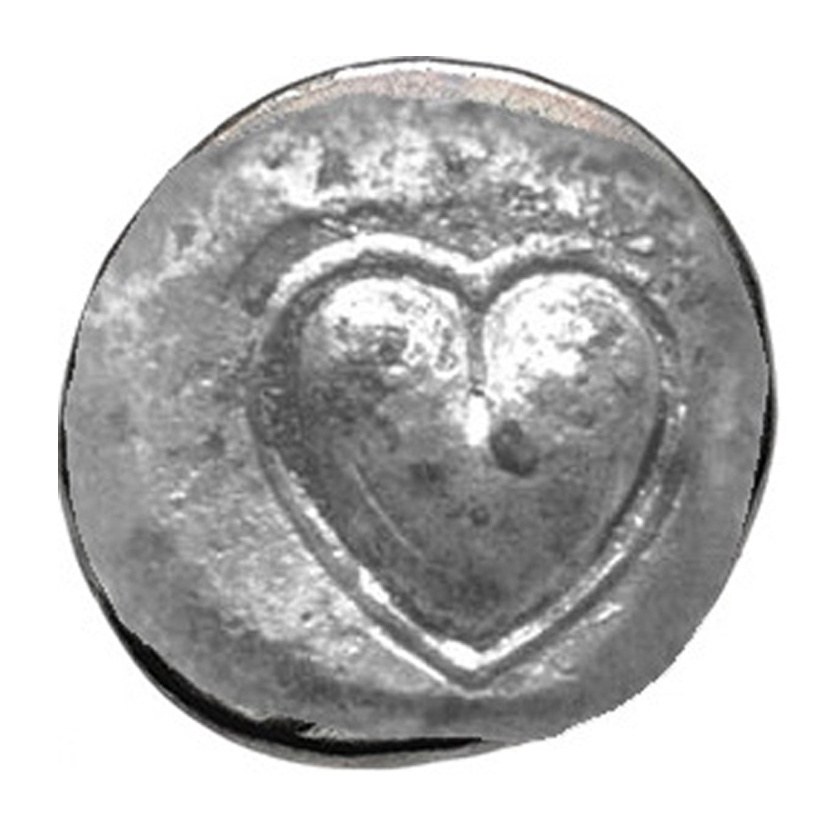

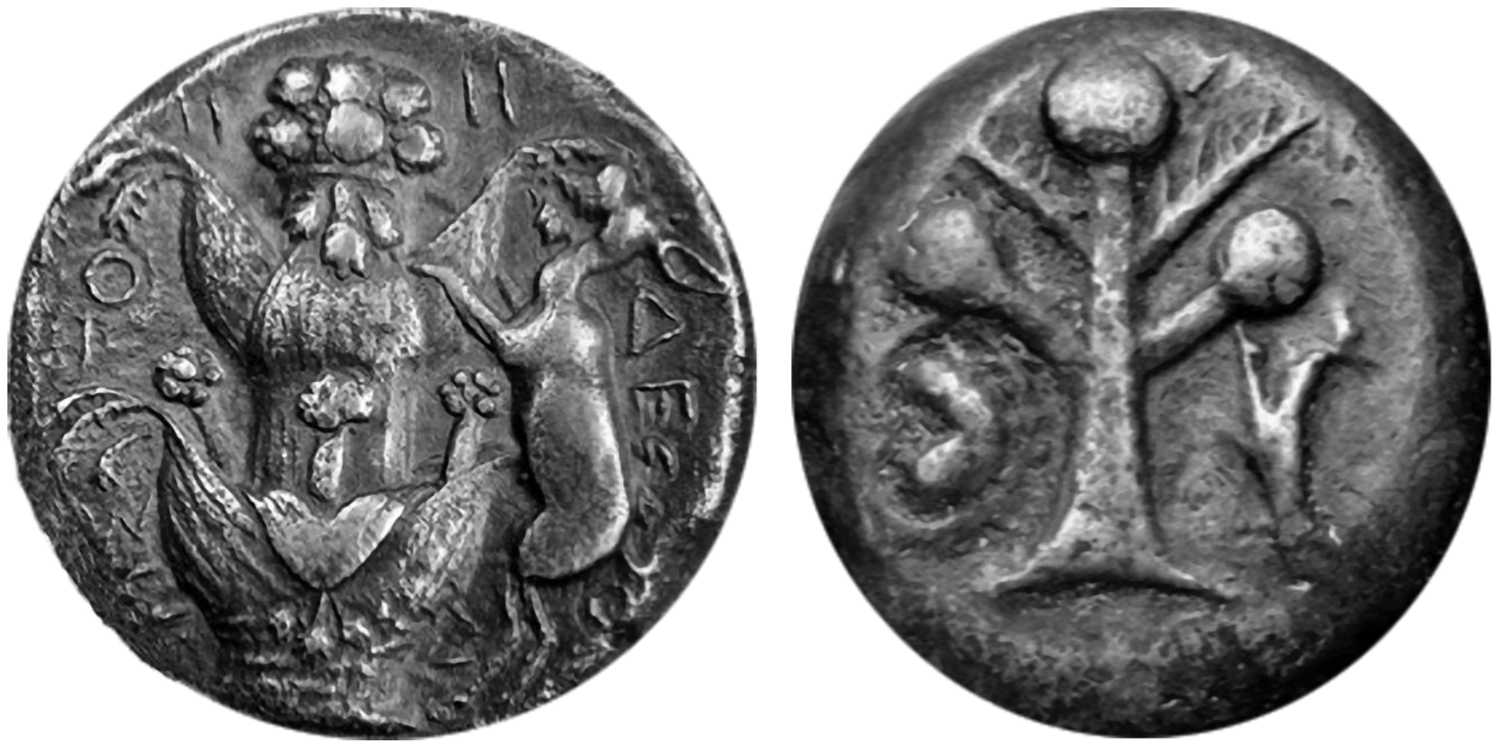

The imagery also includes Ammon, whose head is marked by a ram’s horn, and figures associated with the city. The University of Padua’s CyReNe Project traces changing types, authorities and inscriptions. Its detailed classification makes an important point: a silphium image alone cannot date a coin. Weight, metal, style and lettering must be considered together.
The botanical identity of ancient silphium remains debated. Neither a confident identification with a living species nor a claim that its coin-shaped fruit proves the origin of the heart symbol is justified here. These objects are compelling without the addition of a modern legend.
Mediterranean connections: the currencies of empires
Roman rule placed the coastal regions within new political and monetary structures. Imperial coins carried a ruler’s portrait and images that made authority visible far from Rome. Their movement connected ports, markets, military payments and public revenue. This does not mean that every community or transaction relied on coins: credit, payments in kind, and differences between town and countryside also belonged to the monetary landscape.
Leptis Magna gives this connection with empire a particular resonance. Septimius Severus was born there, became emperor in AD 193, and helped transform its monumental landscape. UNESCO’s description of the harbour, warehouses, market and public buildings suggests a commercial life far richer than a sequence of conquests. Roman coins found in the region should not, however, automatically be attributed to a mint at Leptis.
Following the changes of late antiquity, the Arab conquests of the seventh century gradually incorporated these territories into new political networks. Gold dinars, silver dirhams and copper small change formed part of the vocabulary of Islamic money, with practices varying by period and place. Inscriptions, authorities’ names and dates became crucial evidence for numismatists. Conquest did not instantly create one uniform currency throughout the territory.
The word dinar therefore has a much longer history than Libya’s 1971 reform. Its appearance on a modern banknote does not establish an unbroken institutional lineage, or any continuity in value, with medieval gold coins.
The Tripoli mint: reading an Ottoman coin
Tripoli entered the Ottoman sphere in the sixteenth century. Under the Karamanli dynasty, which governed with considerable autonomy from 1711 to 1835, the port remained connected to Mediterranean trade and inland routes. Coins offer a material route into this history through their mint names. Libya’s Tripoli must be distinguished from similarly named places in the Levant: a catalogue entry saying only “Tripoli” is insufficient.
The British Museum holds a small coin struck at Tripoli under Mahmud II. The photograph here shows a different specimen recorded by the Portable Antiquities Scheme. Its record identifies a para made in the ruler’s twenty-third regnal year, around 1831. The inscription names Tarablus, the Arabic name of Tripoli.
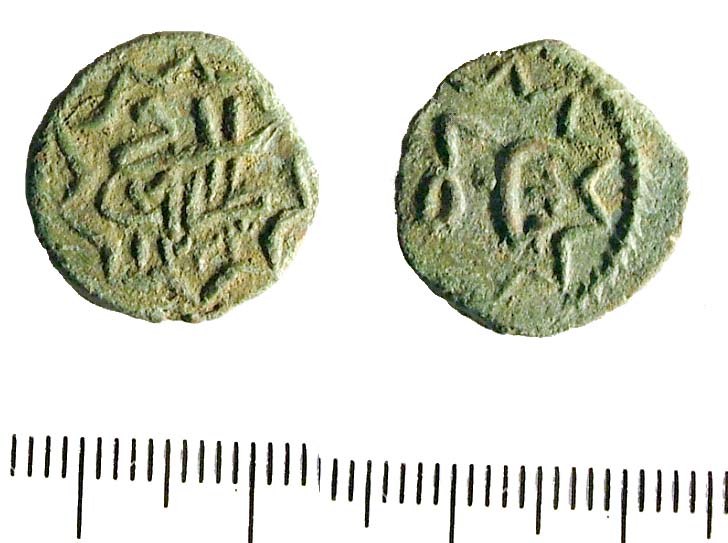

Dating requires care. The Hijri year 1223 refers to Mahmud II’s accession in 1808, rather than necessarily recording when the coin was made. It must be read alongside the regnal year. Ottoman dates cannot always be converted as if they were ordinary calendar dates; the survival of a few small marks may determine the attribution.
This modest object also shows why monetary history should extend beyond prestigious gold issues. Small denominations bring us closer to ordinary transactions. The mint, the issuing authority and the place where a coin was found are separate pieces of evidence: the discovery of this specimen in Britain does not make it British money.
1911–1952: one country, several currencies
Italy’s invasion in 1911 began a colonial period shaped by warfare and a prolonged conquest. Italian lire became part of the currency in use. The North African campaigns of the Second World War then reshaped the territory’s administration. From 1943, Britain administered Tripolitania and Cyrenaica, while Fezzan came under French administration.
On the eve of monetary unification, the three regions did not use the same units: British Military Authority lire in Tripolitania, Egyptian pounds in Cyrenaica, and Algerian francs in Fezzan. The Egyptian pound’s role in the east matters. Describing the reform as simply a choice between lire and francs leaves out one of its three components.
A merchant doing business across these regions could not treat similar-looking numbers as equivalent values. Prices, wages, accounts and debts were expressed in different units. Unification thus had a practical purpose: to establish a common language for payments across the country while arranging the withdrawal and conversion of earlier money.
Libya became independent on 24 December 1951, under King Idris I. Its common currency followed later. Distinguishing the creation of the state from the start of circulation prevents the label “1951 pound” from becoming an inaccurate issue date. The Bundesbank’s currency chronology identifies all three predecessor currencies and their conversion relationships.
24 March 1952: the pound unifies payments
The Libyan pound entered circulation on 24 March 1952. G. A. Blowers and A. N. McLeod’s contemporary IMF study, Currency Unification in Libya, records the decisions while the new arrangements were still taking shape.
The unit was set equal in value to the pound sterling. Its subdivisions, however, did not copy Britain’s twenty shillings and 240 pence. One Libyan pound contained 100 piastres or 1,000 milliemes. An external sterling anchor therefore coexisted with a different domestic counting system. A piastre was ten milliemes, allowing amounts to be expressed in either subdivision.

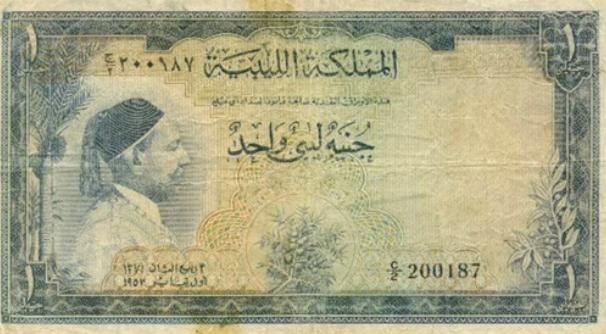

The Libyan Currency Commission administered the reform. Its central task was to issue money backed by sterling assets. This was not yet a central bank with a full range of credit and banking-supervision functions. National banknotes represented new sovereignty while relying on an international financial framework.
The following are historical introduction rates, not present-day exchange quotations or valuations of collectible notes. Their differences indicate the practical scale of the reform: existing prices and holdings had to be translated into one common unit.
| Region | Equivalent predecessor currency |
|---|---|
| Tripolitania | 480 Military Authority lire |
| Cyrenaica | 0.975 Egyptian pound |
| Fezzan | 980 Algerian francs |
The operation went beyond changing the notes in people’s pockets. A common currency supplied the same unit for public accounts, contracts and interregional trade. It gave physical form to the unity of a kingdom whose regions had experienced different administrative and monetary systems.
The kingdom in a pocket: portraits, piastres and milliemes
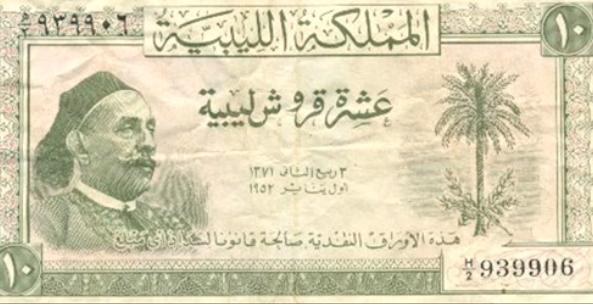
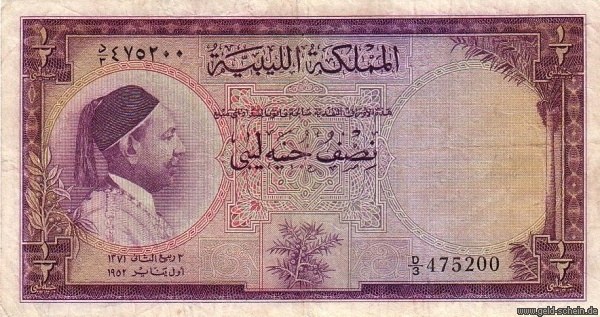
King Idris I’s portrait gave the newly independent state a recognisable face on its banknotes. On the 1952 ten-piastre note, the king appears on the left and a palm tree on the right. The British Museum’s specimen record identifies the green and pale-pink composition. Worth one tenth of a pound, this small note shows that paper money also served payments below the main unit.
Numbers, Arabic lettering, English wording and security patterns support several kinds of reading. Users must recognise the denomination, identify the issuer and distinguish a genuine note from an imitation. The royal portrait is political imagery, but the note is also a technical product: paper, engraving, numbering and signatures work together to support confidence.

The 1952 coinage included small milliemes denominations and piastres. The Al Hamra numismatic museum records examples including a one-millieme and a two-piastre piece. Coins carried the monarch’s presence into smaller transactions. Issues of 1965 used the kingdom’s arms and expressed some values directly in milliemes. A different design or a change in the subdivision written on a coin does not necessarily mean that a new currency has been introduced.
Production required specialist skills, sometimes commissioned abroad. The issuer guaranteeing the currency, the banknote printer, and the coin mint have different roles. A Libyan institution’s name does not prove that a note was printed in Tripoli. Mint and engraver attributions cannot safely be inferred from the appearance of a portrait alone.
1956–1969: building a monetary institution
On 1 April 1956, the central bank began operations, replacing the currency commission. The Central Bank of Libya’s official history distinguishes this operational date from the commission’s establishment in 1951. Treating the two bodies as one would obscure an important stage in state-building.
A currency commission and a central bank can both issue notes, but they do not necessarily perform the same functions. The earlier arrangement concentrated on backing the currency. The institution that followed gradually developed broader responsibilities involving external reserves, banks, credit and financial services to the state.
For anyone reading a banknote, the issuer’s name can therefore be as informative as the portrait. It places an object within an institutional sequence. Two notes denominated in pounds may belong to different phases without any division or multiplication of the currency unit. A new signature may simply record a change of officeholder rather than a monetary reform.
The growth of the oil industry in the 1960s transformed Libya’s financial resources and increased the importance of managing external receipts and public expenditure. That later wealth should not be projected backwards onto 1952. Monetary unification preceded the major expansion of oil exports: the national pound was initially a political and administrative achievement.
1971: a new name without a new scale of value
The overthrow of the monarchy in September 1969 began a new political era. The currency did not change its name on the day of the coup. On 1 September 1971, the pound became the Libyan dinar, as recorded in the Library of Congress country study and the 1971 amendment to the banking law.
The change was at par: one pound became one dinar. The millieme was renamed the dirham, with one thousand dirhams to the dinar. This did not remove three zeros or multiply people’s savings by a thousand. Five pounds became five dinars; the terminology on accounts and currency changed without rescaling the unit.
The first dinar issues brought the new names into everyday use. The 1971–1972 half-dinar held by the Al Hamra museum illustrates the small paper denominations of this early period. Emblems and issuer names must be read in their specific context: a coin from the 1970s cannot stand for all four decades of Muammar Gaddafi’s rule.
This transition explains Libya’s place in a history of pounds. Its present currency is called the dinar, but it continued at equal value the national unit introduced as a pound in 1952. That relationship is more informative than classifying currencies solely by their current names.
The dinar: emblems, memory and heritage
Republican coins and notes changed the visual language of the kingdom. The photographed 50-dirham coin of 1975 is a dated example from before the proclamation of the Jamahiriya in 1977. Wording, arms and political symbols changed more than once. The state’s name on a coin is therefore a chronological clue alongside its date.
Banknotes developed a broader repertoire of portraits, monuments, activities and places of remembrance. Omar al-Mukhtar, associated with resistance to Italian colonial rule, has an important place in Libya’s currency imagery. His portrait must not be mistaken for that of a contemporary ruler. Ancient heritage and urban architecture also help represent the country’s historical depth.
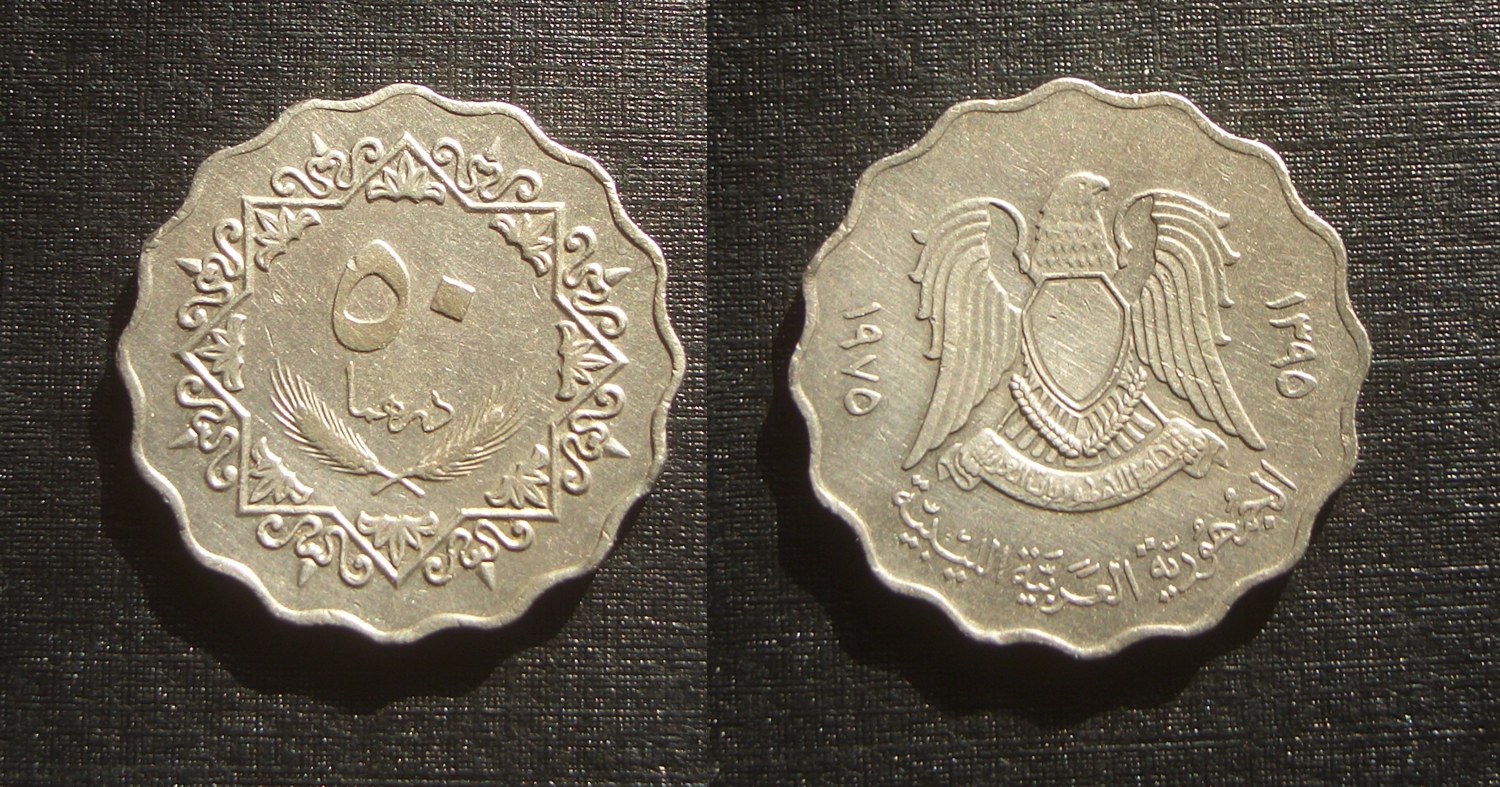

Both sides deserve attention. One may emphasise a figure or emblem while the other presents a building or landscape. The Central Bank’s official banknote presentation separates denominations and faces. It is a stronger starting point for identification than an undated photograph on its own.
A new series also entails physical work. Notes must be produced, transported and distributed; earlier denominations are exchanged or withdrawn under the issuer’s decisions. Changed imagery may carry a political message while also addressing security and cash-management requirements. An old note should not be described as spendable without a verified statement about its withdrawal status.
Since 2011: renewing notes and reconnecting institutions
The revolution and conflict of 2011 led to another transformation of monetary imagery. Symbols associated with the previous regime gradually disappeared from new issues, while references to the flag and revolutionary memory entered the repertoire. Revisions to existing designs must be distinguished from entirely new notes: not every post-2011 issue was redesigned from scratch.
A clearly documented technical development followed in 2019: a one-dinar polymer note. In a release dated 12 March, De La Rue announced Libya’s first issue on its Safeguard substrate. A synthetic material allows a different combination of durability and security features. Changing the substrate does not establish a new monetary unit: one dinar remains one dinar.
Political division from 2014 also affected financial institutions. Currency questions concerned more than design: they included issuing authority, supplies to banks and the coherence of accounts. Production for eastern authorities, including by Russia’s Goznak, forms part of this history. Disagreement between authorities does not justify labelling every such note a counterfeit. A physically forged note and a dispute over the legitimacy of an issue are different problems.
On 20 August 2023, the announcement that the central bank was being reunified was welcomed by the United Nations Support Mission in Libya. This was a dated institutional milestone, not proof that every difficulty had disappeared. The mission’s response to the central-bank crisis in August 2024 shows the institution’s continuing importance to public services and daily life.
How to read Libyan money
Separating the clues makes a coin or note easier to understand. Start with the unit—pound, piastre, millieme, dinar or dirham—to place it within the succession of systems. Then read the issuer, royal titles or state name before examining the date, signatures, serial numbers and imagery. Two objects with the same denomination can belong to different series.
The present subdivision, 1 dinar = 1,000 dirhams, deserves particular care: 100 dirhams make a tenth of a dinar; 250 make a quarter; 500 make a half. This is a relationship within Libya’s own accounting system, not an equivalence with currencies called dirham elsewhere. The Libyan dinar’s code is LYD.
A date may follow the Gregorian or Hijri calendar, or on some older objects record a regnal year. The date a photograph was taken is not the date of issue. An immaculate note may have been withdrawn long ago. A type’s history, an individual specimen’s authenticity and its legal-tender status are three separate questions.
From Cyrene’s plant to the king’s portrait, and from republican emblems to polymer, these objects record connections, institution-building and choices about representation. The 1952 reform gave the country a common monetary language; the 1971 reform renamed its unit without rescaling its value. Those specific continuities, as well as the breaks, make Libya’s money rewarding to examine.
Timeline
- AntiquityCyrene and its silphium coinage
- 1831A para from the Tripoli mint
- 1951Independence on 24 December
- 1952The pound circulates on 24 March
- 1956The central bank begins operations
- 19711 September: one dinar for one pound
- 1975The illustrated 50-dirham coin
- 2019Libya’s first polymer issue
- 2023Announcement of central-bank reunification
Sources and credits
Research checked on 15 October 2026. Sources document dated events; this article does not claim to list every note currently usable.
- Université de Padoue · CyReNe Project
Types, metals and iconography of Cyrene’s coinage.
- UNESCO · Leptis Magna
Urban history and the legacy of Septimius Severus.
- Portable Antiquities Scheme · FindID 113878
Tripoli para: inscriptions and regnal-year attribution.
- British Museum · 1967,0112.790
Evidence for minting at Tripoli under Mahmud II.
- G. A. Blowers & A. N. McLeod · Currency Unification in Libya, FMI, 1952
Contemporary account of the reform and circulation from 24 March 1952.
- Deutsche Bundesbank · Exchange rate statistics, metadata
Libya entry: predecessor currencies and the 1952 conversion rates.
- British Museum · 1952,1206.6
Identification of the 1952 ten-piastre note.
- Banque centrale de Libye · History
1 April 1956, central-bank functions and the dinar’s subdivision.
- Library of Congress · Libya: a country study, 1987
Historical context; the at-par renaming of 1 September 1971.
- Musée Al Hamra · Monnaies de Libye
Objects of 1952 and 1965; political dates in the records were cross-checked.
- Musée Al Hamra · Demi-dinar 1971–1972
Evidence of early dinar issues.
- Banque centrale de Libye · Banknotes
Reference for note faces and denominations; access does not imply permission to reproduce.
- De La Rue · Communiqué du 12 mars 2019
Printer’s release republished by MarketScreener: one dinar on Safeguard.
- Ministère italien des Affaires étrangères · Russia Soft Power, 2024
Context for Goznak production for eastern authorities.
- UNSMIL · 20 août 2023
Announcement of central-bank reunification.
- UNSMIL · 26 août 2024
Institutional crisis and continuity of public services.
- Mahmut Miski · Plants 10 (2021), 102
Source publication for the silphium illustration; botanical identification treated as a hypothesis.
- OMPI · Loi libyenne n°9 de 1968
Copyright; the term for works by legal entities appears in Article 20.
Image credits
The seven local reproductions are credited beneath each figure. Creative Commons photographs retain their licences; the manifest distinguishes photographic rights from rights in currency designs. Recent banknotes are described and linked to the official catalogue, without reproducing designs whose rights have not been sufficiently established. Historical images do not constitute an inventory of circulating currency.