A boat on a small coin. A pearl diver on the back of a large banknote. Kuwait’s modern currency preserves the memory of a country shaped by the sea.
Introduced in 1961, the dinar gave a national unit to a much longer monetary story. Following it means exploring Indian connections, a nineteenth-century local coin, the building of monetary institutions and the return of new notes after liberation in 1991. It also means discovering how a door, a column from Failaka, a turtle or a sailing vessel can become images of a nation.
01 · Before the dinar: Gulf routes
Money reached ancient Kuwait along routes linking Mesopotamia, Arabia and the Indian Ocean. Failaka island, known as Ikaros in the Hellenistic period, preserves tangible evidence of those connections. Finds examined by numismatist Otto Mørkholm include Seleucid coins and pieces repeating the types of Alexander the Great.
One hoard analysed in his 1960 study combines a coin of Antiochus III with twelve Alexander imitations. A ruler’s name could remain in circulation long after his death: a familiar design helped a coin gain acceptance far from its mint. The precise mint of the imitations remains a matter of attribution; their discovery does not establish that they were struck on Failaka.
These objects were not the first “Kuwaiti dinars”. They belong to the much longer history of exchange within the territory of present-day Kuwait. That archaeological record should be distinguished from the creation of a national currency in the twentieth century.
02 · Merchants’ silver, long before oil
Kuwait’s port developed in a world where the sea provided both trade routes and livelihoods. Shipping, Indian connections and pearl diving explain its monetary history more effectively than a list of rulers alone. Foreign coins could be valued for their metal, familiarity and usefulness in payments at the next port.
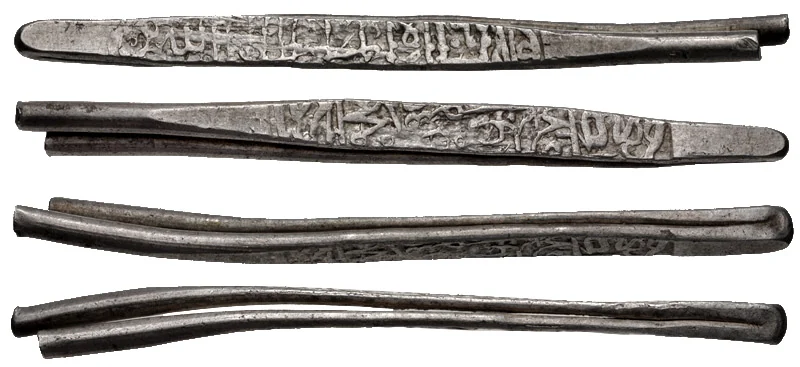
The larin illustrates the variety of monetary forms around the Indian Ocean: it resembles a bent, stamped rod rather than a round disc. The photograph shows Safavid examples as a regional comparison, without claiming a Kuwaiti provenance. Nor does the name of a monetary form identify a single issuing authority.

Later, the Maria Theresa thaler and Indian rupee became part of the Arabian Peninsula’s monetary history. An IMF study published in 1975 describes the thaler’s role and the subsequent growth of Indian paper currency in several Gulf territories, including Kuwait. This transition did not mean that every port changed currency on the same day.
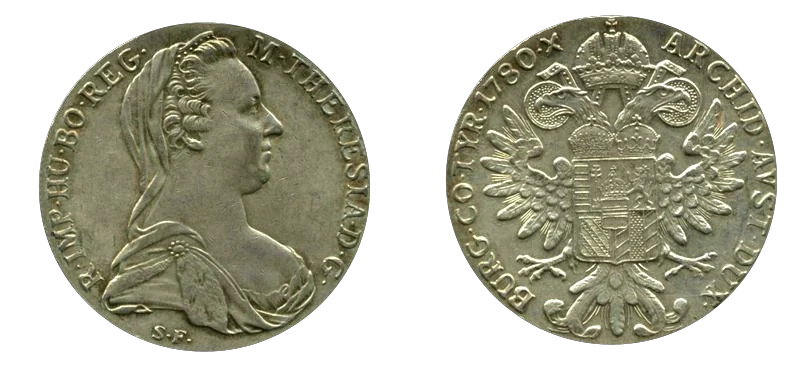

The portrait of an Austrian empress on a coin used far beyond Europe may seem surprising. It reminds us that a currency’s commercial reach is different from political sovereignty. Merchants’ confidence in a familiar silver coin could cross borders.
Wikimedia Commons · Larins safavides / Safavid larins · IMF · Currency Arrangements and Banking Legislation in the Arabian Peninsula (1975)
03 · 1886: an early Kuwaiti signature
Before the dinar, one local experiment acquired a special place in national memory: the pice, or baiza, associated with Sheikh Abdullah II Al-Sabah. The Central Bank identifies AH 1304, rendered as 1886 in its official chronology, as the date of this first Kuwaiti coin.
Its significance goes beyond its small denomination. The name “Kuwait” and the ruler’s signature gave local authority a visible presence on a means of payment. The port was not simply receiving other people’s money: it was also asserting its own name.
The 130th-anniversary collector coin of 2016 repeats these elements. It helps identify the historical design, but does not establish the extent or duration of nineteenth-century circulation. It would be misleading to describe the pice as the beginning of an uninterrupted national monetary system leading to the dinar. The rupee subsequently retained a central role.
04 · The rupee: India, then a separate Gulf issue
The rupee was more than a foreign interlude. It belonged to the commercial relationships connecting Gulf ports with India. Its use involved coins, notes and accounts: related forms of money that did not necessarily change at the same moment.
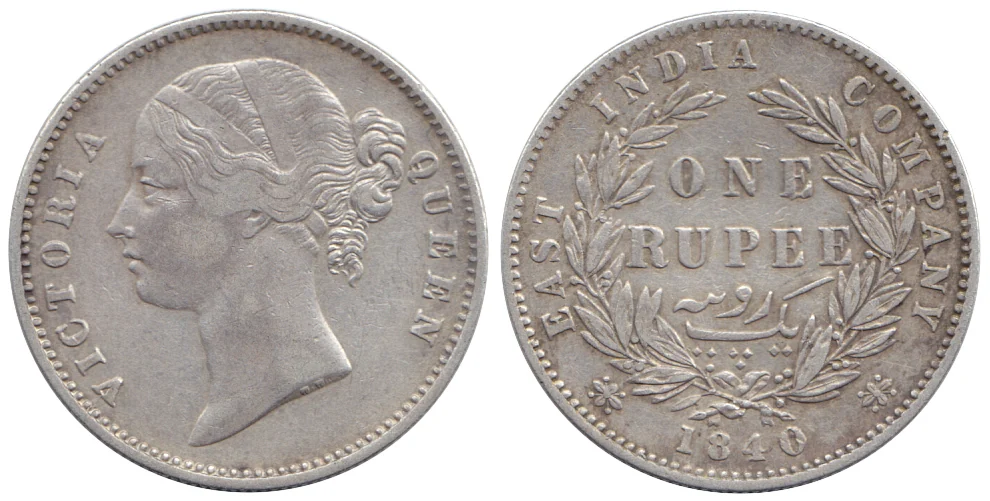

The Reserve Bank of India records the long and widespread circulation of Indian issues in the Gulf. In 1959, separate notes were created for the region, including Kuwait, Bahrain, Qatar and the Trucial States. Distinct issues were intended to curb abuses and gold-related movements that put pressure on India’s foreign exchange reserves.
The “Gulf rupee” was therefore an issue intended for a defined circulation area, not an earlier name for the dinar. Its appearance, colours and series distinguished it from notes used within India. It should also be distinguished from special notes intended for pilgrims.
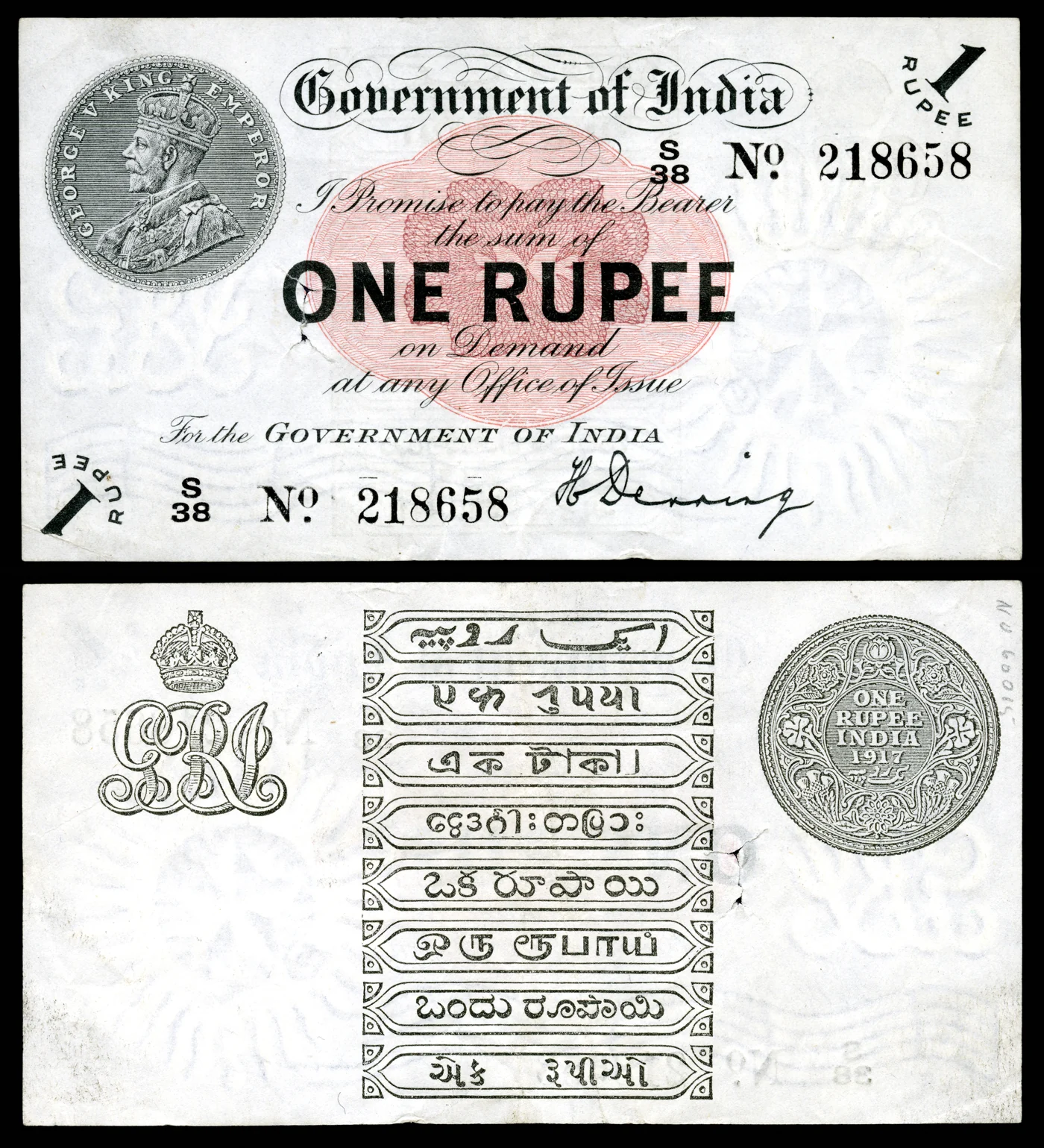

For Kuwait this was a short phase: the dinar arrived in 1961. Other territories left the rupee system at different times. Gulf monetary history was not one simultaneous reform; each emerging monetary authority organised its own transition.
Reserve Bank of India · Persian Gulf Issues · IBRD / World Bank · The Economic Development of Kuwait (1965)
05 · 1961: a national dinar
The first issue followed Amiri Decree No. 41 of 1960. It established the dinar as the national unit and created the Kuwaiti Currency Board, chaired by the Minister of Finance and Economy, Sheikh Jaber Al-Ahmad Al-Jaber Al-Sabah. The notes entered circulation on 1 April 1961.
The first dinar therefore preceded political independence in June. The two events should not be artificially collapsed into one. The currency expressed institutional preparations already under way: defining the unit, arranging its issue and replacing previous money.
The dinar is divided into 1,000 fils. The transition used a conversion of 13⅓ rupees to one dinar, within the sterling-linked parities of the time. The World Bank’s report describes an exchange period continuing until 17 May 1961. For the public, such a reform meant learning to relate new amounts to familiar prices.
The first notes were for ¼, ½, 1, 5 and 10 dinars. Abdullah Al-Salem Al-Sabah’s portrait placed them within the reign in which they were introduced. The issuer was the Currency Board: attributing the 1961 notes to the Central Bank would be an anachronism.
CBK · First Issue · IBRD / World Bank · The Economic Development of Kuwait (1965)
06 · Fils: a boat in the palm of the hand
Coins also entered circulation on 1 April 1961. The series comprises 1, 5, 10, 20, 50 and 100 fils. Twenty fils represent one fiftieth of a dinar; 100 fils represent one tenth. A quarter-dinar note is worth 250 fils. This arrangement is not simply a denomination ladder based on hundredths.
A traditional sailing vessel and the dates are key features of the coins; the other side identifies the country and denomination. The maritime silhouette recalls a port whose prosperity preceded oil. On small coins designed to pass from hand to hand, the vessel provides an instantly recognisable signature.
Different diameters help distinguish denominations: the Central Bank lists 26 mm for 100 fils and 23 mm for 50 fils. Yet diameter does not rise consistently with value: the 10-fils coin measures 21 mm, while 20 fils measures 20 mm. Colour and inscriptions matter too.
A Royal Mint reference collection, including a documented 1961 proof set catalogued by Noonans, records the connection with British manufacture. Issuer and mint are different concepts: the country named on a coin does not identify where every dated example was struck.
CBK · Coins · Noonans · Royal Mint proof-record coins, Kuwait 1961, lot 405
07 · Six series, one unit
The Central Bank succeeded the Currency Board within the institutional framework of the 1968 law. The second banknote series made that new issuing authority visible. It appeared in two stages: 17 November 1970 for ¼, ½ and 10 dinars, followed by 20 April 1971 for 1 and 5 dinars.
A new series did not mean a new unit. Changes to designs, signatures or security did not divide prices by a thousand or turn existing dinars into “new dinars”. Kuwait’s history requires us to follow changing objects while recognising the continuity of their name and subdivisions.
| Series | First circulation | Historical marker |
|---|---|---|
| I | 1 April 1961 | Currency Board; rupee replacement |
| II | 1970–1971 | Issued by the Central Bank |
| III | 20 February 1980 | 20 dinars added on 9 February 1986 |
| IV | 24 March 1991 | Monetary recovery after liberation |
| V | 3 April 1994 | A new generation of security |
| VI | 29 June 2014 | Architecture, heritage and accessibility |
08 · 1990–1991: restoring trusted money
The third series, introduced on 20 February 1980 during the reign of Jaber Al-Ahmad Al-Jaber Al-Sabah, gained a 20-dinar note on 9 February 1986. It was the series caught up in the political and monetary rupture following Iraq’s invasion on 2 August 1990.
After liberation in February 1991, restarting banking and payments required identifiable cash. The fourth series entered circulation on 24 March 1991 to speed the exchange of the third and support the resumption of transactions. Withdrawal of the third began that same day, and it ceased to be legal tender forty-five days later. Exchange at the Central Bank ended on 30 September 1991.
This compressed timetable distinguishes the operation from ordinary note replacement. For a household or merchant, money recognised yesterday had to be identified by series and replaced within the deadline. Two pieces of paper bearing “dinar” and the same denomination could have different legal standing: trust also depended on the issuer specifying which notes it continued to honour.
Withdrawal of the fourth series began on 17 August 1994. It ceased to be legal tender on 16 February 1995, with Central Bank exchange continuing until 16 August 2004. The dinar retained its unit through these changes; replacing notes should not be described as removing zeros.
09 · From 1994 to 2014: new notes, familiar values
The fifth series appeared on 3 April 1994, drawing on the banknote printing and security advances of its period. Twenty years later, the sixth was launched on 29 June 2014. The six denominations, from ¼ to 20 dinars, remained unchanged.
These transitions involve several dates that should be kept distinct. A launch introduces new notes; withdrawal manages the departure of earlier ones; loss of legal-tender status ends their role as legal payment; an additional period may allow exchange at the issuing institution.
A banknote can retain historical interest after its payment function ends. It becomes evidence of printing methods, the monuments chosen and the signatures of its period. Any collector value is a separate matter from face value and cannot be inferred from it.
10 · Six notes, six ways to read Kuwait
The 2014 series pairs buildings on its fronts with heritage, nature and economic activity on its backs. Colours vary, while a common background takes inspiration from the national flag. Following the denominations upwards offers a way of exploring the country.
The following entries describe motifs documented by the issuer. They provide a reading guide without reproducing official images, whose commercial reuse requires permission.
250 fils · 110 × 68 mm
Liberation Tower / The pice returns
The brown quarter-dinar note brings the Liberation Tower together with domestic heritage. On the back, a traditional door and plasterwork accompany the first local coin. A modern banknote thus becomes a small museum of money, carrying the memory of an earlier monetary object.
500 fils · 120 × 68 mm
The towers and marine life
The green half-dinar depicts Kuwait Towers. A hawksbill turtle and the silver pomfret known as zubaidi place the urban landmark within its marine environment. The sea appears as a living habitat as well as a commercial route.
1 000 fils · 130 × 68 mm
From the Grand Mosque to Failaka
The grey one-dinar note features the Grand Mosque. An Ionic column on its back evokes Failaka’s Greek heritage. The pairing connects two historical layers without conflating them: Islamic culture and Hellenistic archaeology.
5 000 fils · 140 × 68 mm
The bank, refinery and tanker
The purple five-dinar note depicts the new Central Bank headquarters, with a refinery and oil tanker on the back. This pairing gives visual form to financial institutions and a resource central to Kuwait’s transformation, without explaining the dinar’s entire history by itself.
10 000 fils · 150 × 68 mm
Public architecture and desert heritage
The reddish-orange ten-dinar note shows the National Assembly building. On the back, a falcon appears beside a seated camel wearing a saddle decorated with traditional sadu weaving. These motifs record the 2014 design programme; they are not a statement about institutional arrangements at every later date.
20 000 fils · 160 × 68 mm
The palace and the memory of pearls
The blue twenty-dinar note depicts Seif Palace. A large boom dhow and a pearl diver appear on the back. The series’ largest denomination thus recalls the maritime labour and trade that sustained the port before the oil economy.
11 · Money to recognise by touch and sight
Dimensions follow a progression: the 2014 notes retain a height of 68 mm, while their length rises from 110 to 160 mm in 10 mm steps. Size provides an additional identifying feature alongside colour and the printed denomination.
The issuer explicitly considered people with visual impairments: larger numerals and raised printing help distinguish the notes. Security is not solely a matter for banking machines; money also needs to be recognisable to the hand and eye.
Official specifications describe a falcon watermark incorporating the denomination, a security thread and incomplete shapes that combine when held against the light. Colour effects seen when tilting vary by denomination; the five-, ten- and twenty-dinar notes include an optical movement effect. Ultraviolet light reveals further elements.
An ordinary photograph cannot demonstrate all these properties. Links to the issuer explain their operation; this dossier describes them as manufacturing characteristics, without attempting to authenticate any particular specimen.
CBK · Sixth Issue · CBK · Sixth issue, quarter dinar · CBK · Sixth issue, five dinars
12 · Commemorative issues: remembering without changing the unit
The Central Bank lists commemorative banknotes for the second and tenth anniversaries of liberation separately. They are dated 26 February 1993 and 26 February 2001 respectively. Their separate category distinguishes them from the six ordinary banknote series.
An anniversary, printed value and central bank name do not by themselves establish that an object is intended for everyday purchases. A collector issue should be distinguished from an ordinary circulating issue, avoiding the mistake of treating every monetary souvenir as another currency reform.
The 2016 pice commemorative coin follows the same process of historical transmission. It repeats the name of Kuwait, the date AH 1304 and Abdullah II’s signature. Comparing this commemorative metal issue with the pice represented on the 2014 quarter-dinar note reveals a memory carried across different media.
Numismatics also studies such conversations between objects. A small nineteenth-century coin becomes a historical symbol chosen for a twenty-first-century issue. Its later significance rests not only on its former purchasing power but also on what it can tell us about local authority and identity.
CBK · Second anniversary of liberation, 26 February 1993 · CBK · Tenth anniversary of liberation, 26 February 2001 · CBK · First Kuwaiti Currency, Pice (8 November 2016)
13 · The dinar’s anchors: pursuing stability
Choosing an external reference is another part of monetary history. The Central Bank describes a weighted currency basket from 18 March 1975 until the end of 2002. From 5 January 2003 to 19 May 2007, the dinar was pegged to the US dollar within specified margins. On 20 May 2007 it returned to a currency basket whose composition is not disclosed.
These choices matter in a country closely connected to external trade: movements in suppliers’ currencies can affect the prices of imports. A basket seeks relative stability against several partners; it does not imply an absence of movement or an absolute guarantee of purchasing power.
From imported silver to notes depicting the country itself, the Kuwaiti dinar’s story follows the emergence of national monetary authority in a region long open to the world. The vessel on its coins and the pearl diver on the twenty-dinar note preserve that connection: the memory of the sea remains present in the money of the modern state.
Sources and credits
Sources checked on 15 October 2026. Links lead to archaeological research, monetary institutions and object records. Facts and dates are synthesised in original prose; the four local images have individual credits. External references require a connection, while the article and images can be read offline.
- Otto Mørkholm · Græske mønter fra Failaka (1960)
- Wikimedia Commons · Larins safavides / Safavid larins
- Reserve Bank of India · Persian Gulf Issues
- IMF · Currency Arrangements and Banking Legislation in the Arabian Peninsula (1975)
- CBK · First Kuwaiti Currency, Pice (8 November 2016)
- CBK · First Issue
- IBRD / World Bank · The Economic Development of Kuwait (1965)
- CBK · Second Issue
- CBK · Coins
- Noonans · Royal Mint proof-record coins, Kuwait 1961, lot 405
- CBK · Third Issue
- CBK · Fourth Issue
- CBK · Fifth Issue
- CBK · Sixth Issue
- CBK · Sixth issue, quarter dinar
- CBK · Sixth issue, half dinar
- CBK · Sixth issue, one dinar
- CBK · Sixth issue, five dinars
- CBK · Sixth issue, ten dinars
- CBK · Sixth issue, twenty dinars
- CBK · Second anniversary of liberation, 26 February 1993
- CBK · Tenth anniversary of liberation, 26 February 2001
- CBK · Exchange Rate Policy
- CBK · Disclaimer / Conditions de réutilisation
Illustrations show monetary antecedents and regional context, explicitly identified in their captions. Modern and commemorative Kuwaiti notes are described; official images are not reproduced without commercial permission. See the image manifest.