A shared history of the dinar
From Roman silver to the gold of the caliphates, from Saharan routes to modern banknotes, a name passes between languages and societies. Behind that family resemblance, monetary systems change, end and take on new forms.
This story leads to eight independent currencies. Linguistic descent is different from uninterrupted monetary continuity: every name needs a date, an issuer and a setting.
Rome: a small silver coin in a world at war
The dinar’s earliest namesake was not a gold coin. It was a silver denarius, born in a Roman Republic fighting for its future.
Around 211 BCE, during the Second Punic War, Rome was confronting Carthage. Military campaigns required supplies and payments on a large scale. The denarius appeared during this reorganisation. Scholars conventionally place the reform around 212–211 BCE; this is a historical marker, rather than the precise birthday of a coin. [1]
Its name referred to ten: initially worth ten bronze asses, the denarius often carried an X. On early issues, the helmeted head of Roma faced the Dioscuri, Castor and Pollux, riding on the reverse. Divine protection, civic identity and victory fitted into an object small enough to pass from hand to hand.
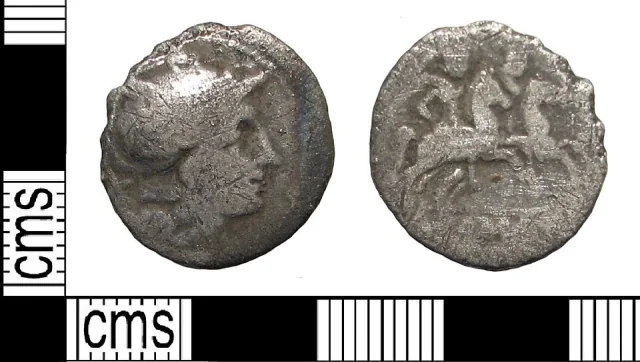

A currency travels with Rome
The denarius accompanied Roman expansion, paying soldiers, settling obligations and forming reserves far from its mint. Its reach did not mean everyone in the empire paid in the same way. Bronze, local coinages and other silver traditions remained important. A dominant currency could coexist with regional practices.
Late Republican moneyers used reverses to recall family ancestors and achievements. Later, portraits of living rulers became central. Imperial titles, victories and virtues travelled with their likenesses. For people who would never see an emperor, a coin gave authority a familiar face.
This success was not unchanging. Weight and silver content varied, with debasement becoming particularly marked under the empire. In the third century, other issues, including the coin now called the antoninianus, progressively displaced the denarius. The object lost its former role, but its name survived. Monetary words can outlast monetary systems. [2]
The name survives; metals and empires change
Centuries separate the Republican denarius from the Islamic dinar. They should not be presented as a single coin gradually transformed without interruption. Their relationship is first linguistic. French denier descends from Latin denarius, as do relatives such as Italian denaro and Spanish dinero. Arabic dīnār belongs to this long history of borrowing through the contact zones of the eastern Mediterranean. It was not a name invented for a twentieth-century currency. [3] [4]
Constantinople and the strength of the solidus
In Late Antiquity, the solidus, introduced under Constantine in the early fourth century, became the principal Roman gold reference. The eastern Roman rulers we call Byzantine continued to mint it. An imperial portrait on reliable gold offered a model of authority and trust well beyond Constantinople.
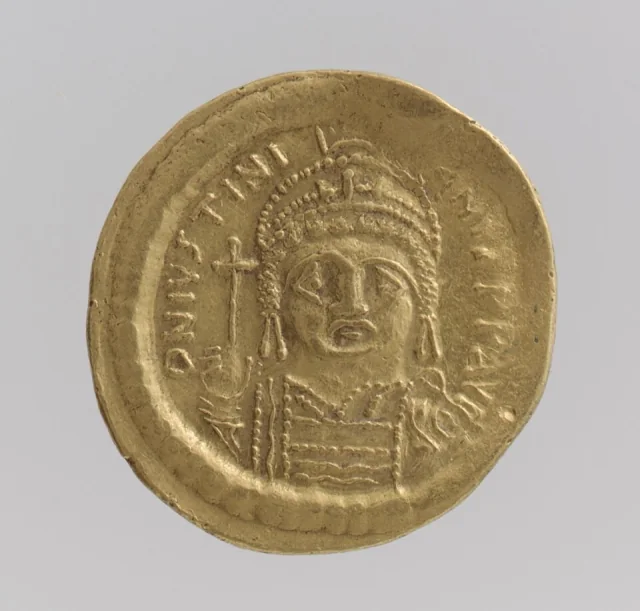

The illustrated solidus of Justinian I shows a helmeted ruler facing the viewer. Other Byzantine types combine crosses, imperial figures and Christian inscriptions. Gold and political authority were inseparable. The state paid armies and collected taxes: coins circulated within this fiscal system as well as along trading routes. [5]
Iran: a different monetary language
Further east, Sasanian coinage was dominated by the silver drachm. The king appeared in profile, often identifiable by his crown. A fire altar, usually flanked by two attendants, linked the reverse to Zoroastrian religion and kingship. Gold issues existed but did not have the same everyday role as silver. [6]
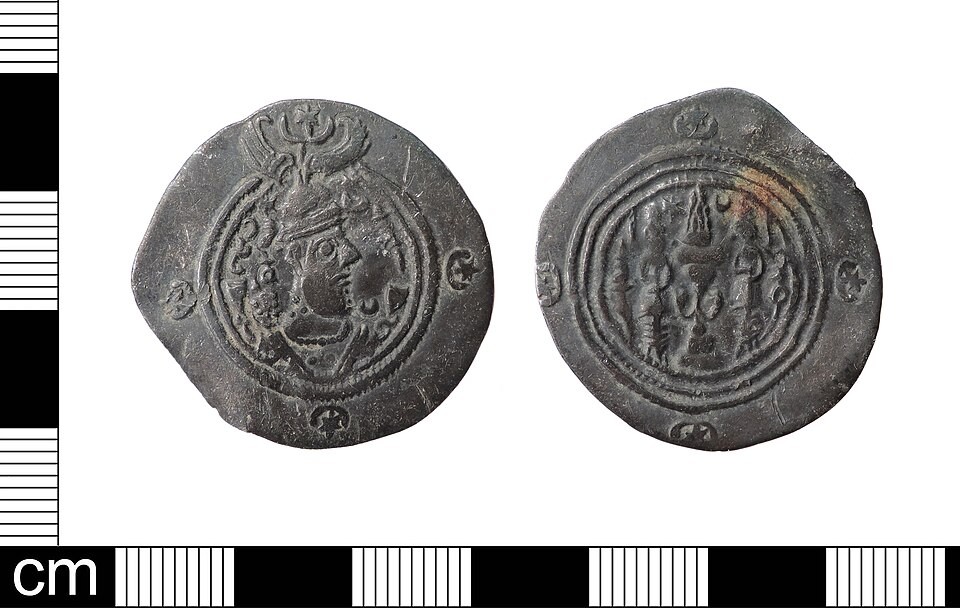

The seventh-century Arab conquests brought together former Byzantine and Sasanian territories with established mints, workers and payment habits. The future gold dinar emerged from this multiple inheritance: an old name, eastern practices and an immediately recognisable gold model.
The first Muslim authorities begin by adapting
A change of ruler did not empty markets of their money. Taxes still had to be collected, soldiers paid and transactions completed. In the early decades of Islam, authorities reused familiar designs: Byzantine-inspired coins in the west and Sasanian-style drachms in the east. Changes were gradual, local and sometimes experimental.
Arab-Sasanian issues retained royal portraits and fire altars while adding Arabic phrases or the names of new authorities. An inherited image beside a new inscription was a practical way to make political change visible without making an essential payment instrument unfamiliar. [7]
A standing caliph before the age of inscriptions
Under Abd al-Malik, Umayyad caliph from 685 to 705, some gold coins displayed a standing figure conventionally identified as the caliph. These transitional issues of the 690s are striking evidence of an official human representation before the adoption of wholly epigraphic gold types. [9]
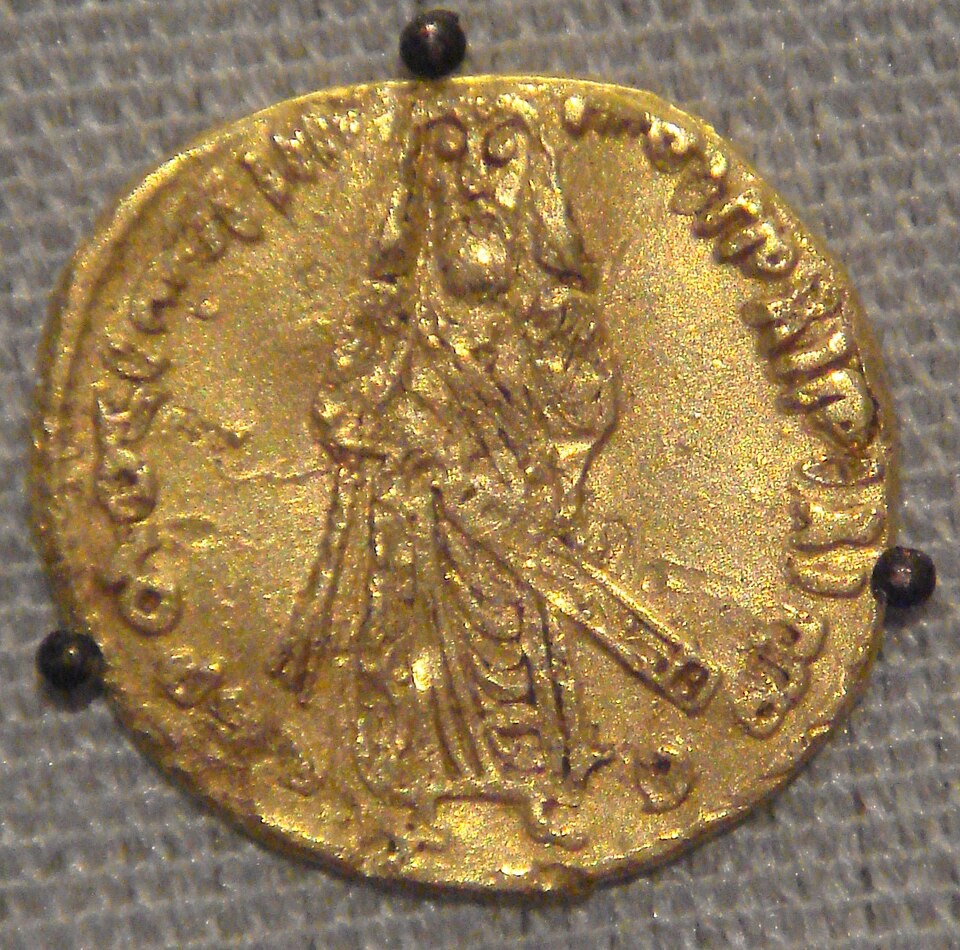

Early Islamic money did not begin with one fixed visual formula. Surviving objects show experiments, borrowings and abandoned designs. The change concerned religion, but also the capacity of central government to establish common signs across an enormous territory.
The word dinar already belonged to the vocabulary of gold before the final reform: it appears in the Quran, surah 3, verse 75. Abd al-Malik invented neither the name nor gold money. His reform gave a new issue a form, inscriptions and a standard that became major points of reference. [4] [8]
Abd al-Malik: gold becomes a written page
A change across a few centimetres could announce an imperial transformation. On the epigraphic dinar, writing occupied the space once reserved for the ruler. AH 77, corresponding to 696–697 CE, marks the appearance of the gold type associated with the Umayyad reform.
Its theoretical weight was about 4.25 grams. This was a standard, not a claim that every surviving specimen must weigh precisely the same. Manufacture, wear and each object’s history must be taken into account. [4] [10]
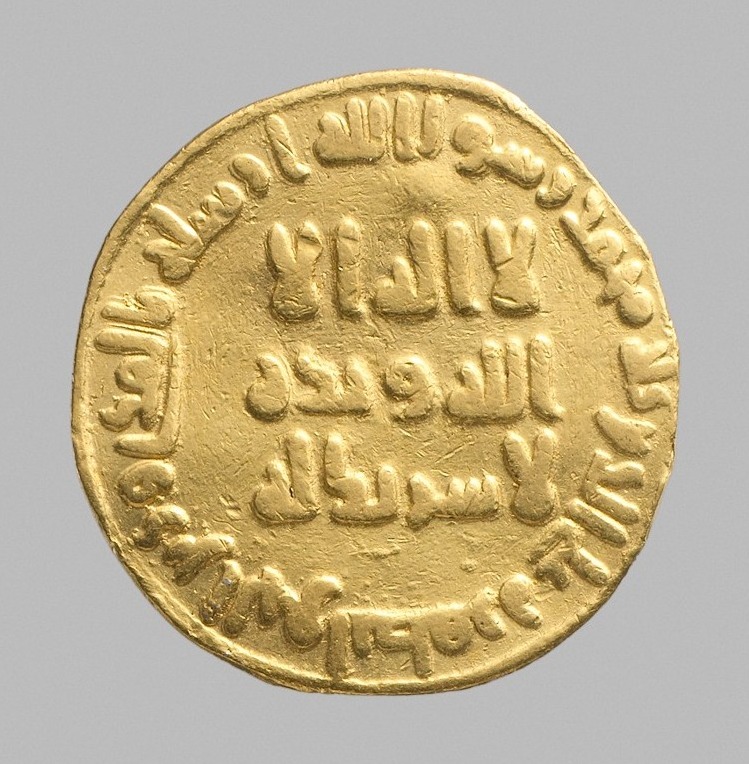
The Metropolitan Museum example illustrated here dates to AH 79 / 698–699 CE, two years after the reform’s first reference date. It is not an AH 77 specimen. Statements of faith and Quranic passages occupy the centres and margins of both sides. Instead of recognising a portrait, users could read a text, have it explained or recognise its arrangement. [8] [10]
Sovereignty without a portrait
Arabic inscriptions and shared religious formulas distinguished the new coin from Byzantine issues across a multilingual empire governed from Damascus. The monetary reform belongs to the same historical setting as other major Umayyad programmes, including the Dome of the Rock in Jerusalem. It was more than a redesign. [9]
“Epigraphic” simply means that inscriptions form the main design. Such a coin is not devoid of visual expression. Lines, circles, the rhythm of letters and empty space create a powerful identity. Authority can be represented through words as well as a face.
Calendars matter
An Islamic year is lunar and usually overlaps two Gregorian calendar years. AH 77 / 696–697 is therefore more precise than automatically assigning one Islamic date to one civil year. Dates here follow the collection records and retain their stated degree of precision.
Inside the mint: engraving, striking, checking
Before becoming money, gold had to be supplied, prepared and checked. A blank, or flan, was placed between engraved dies, whose designs were struck into the metal. Off-centre strikes, incomplete letters and irregular edges remind us that medieval coins were not products of a modern industrial line.
A numismatist begins with practical questions. What is on each side? Where is the date? Is a mint name actually present? Which titles accompany the ruler’s name? A coin might acknowledge a distant caliph while naming a prince who exercised local power. This miniature map of allegiances need not describe effective political submission. Finds at Nishapur illuminate such relationships between caliphs, dynasties and governors. [13]
Metal, inscription and context must be read together. Gold, silver or copper cannot be inferred from a currency name alone. Statements of faith, names, titles and dates occupy chosen positions. Hoards, archaeological finds and archives add evidence that a coin cannot provide on its own.
Weights require the same care as legends. A recognised type might be accepted by count in one setting and weighed in another. Scales, standard weights and the reputation of issues all belonged to the history of trust. A shared name guaranteed neither identical fineness nor a permanent equivalence.
A mint is a place of production, not a modern border. A coin made in Fez, Almería or Baghdad first describes the political geography of its own time. Giving it a present-day nationality too quickly would obscure the empires and networks that made it meaningful.
The Abbasids: a shared language in a diversifying world
The fall of Umayyad rule in the east in 750 did not end the dinar. The Abbasids retained much of its epigraphic language while developing their own arrangements. Political power moved towards Iraq; Baghdad, founded in 762, became a major centre of government and exchange. [12]
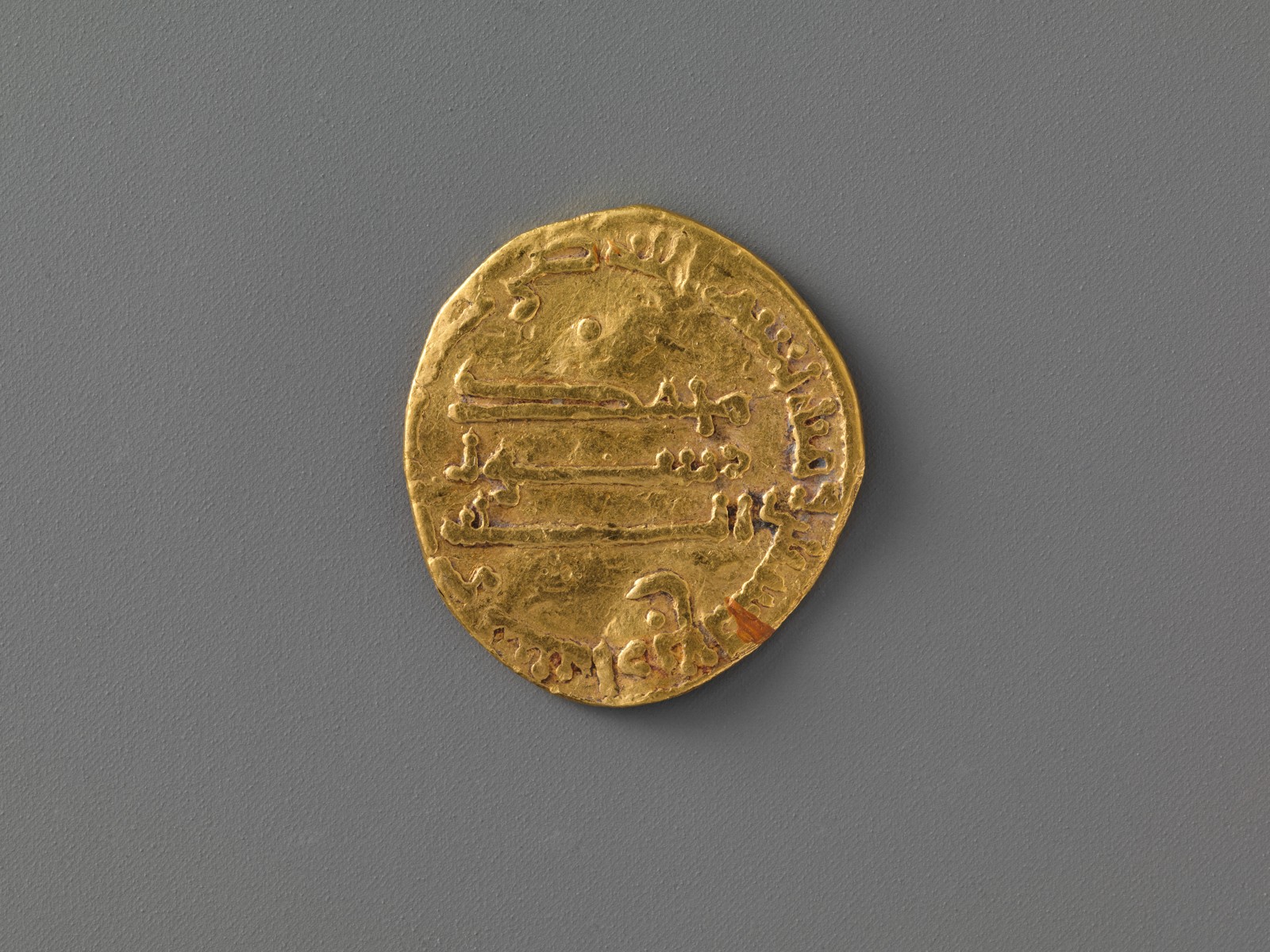
The illustrated dinar from al-Mahdi’s reign is dated AH 164 / 780 in the Metropolitan Museum catalogue. It offers a lesson in method: the year is inscribed, but the mint is not. Attribution cannot consist of reading information that the object does not contain. Proposed locations may instead depend on comparisons, series and knowledge of monetary administration. [11]
Several authorities on one face
In later centuries, Islamic political authority fragmented without abandoning every common convention. A caliph, regional ruler, heir or governor could appear together in a coin’s titles. Samanid, Buyid, Ghaznavid and Seljuq issues belong to this history. Lettering and layout help distinguish series that initially seem alike. [13]
These dinars were not a single currency run by a medieval central bank. Minting regions, gold-to-silver relationships and conditions of acceptance evolved. Common signs made coins intelligible without erasing differences between markets.
That is part of their fascination today. A coin may preserve the name of a short-lived power, a claimed relationship or a change of allegiance that a broad historical narrative overlooks. The small object becomes a durable political archive.
The Fatimids: golden circles of a rival caliphate
From 909, the Fatimids built power in North Africa before conquering Egypt in 969. Cairo became their capital during the following decade. Their Ismaili Shia caliphate claimed a legitimacy that rivalled the Abbasids, and gold coins carried that claim. [14]
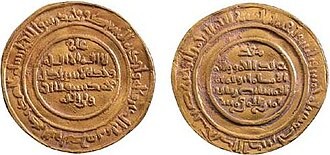

Fatimid dinars display varied compositions. On several types, inscriptions run in concentric rings: the eye follows the circles before deciphering the words. Titles, names and religious statements are political assertions, not mere ornament. The illustrated example, attributed to al-Mustansir and dated AH 435 / 1043–1044, shows this arrangement. Its photographic record does not securely identify a mint; the Alexandrian museum object cited among the references is a different specimen. [15]
From princely treasuries to merchants’ archives
Egypt connected Mediterranean exchange to the Red Sea and Indian Ocean. Gold tells more than a story of international commercial profits. Documents preserved in the Cairo Geniza, considered alongside coin finds, record rents, dowries, property purchases and merchants’ settlements. They give amounts expressed in dinars a social setting. [16]
A written sum in dinars does not necessarily mean that an equal number of identical gold coins was placed on a table. Units of account, available cash and settlement practices are different things. A contract is not a photograph of a purse.
The reputation and circulation of Fatimid gold encouraged imitations in the eastern Mediterranean. A coin could cross the political boundaries separating its users from its issuer. Trade did not remove rivalries; objects could nevertheless pass through them. [15] [20]
Gold crosses the Sahara and connects two shores
To understand the Maghreb’s dinars, look south of the desert as well as north across the Mediterranean. Trans-Saharan routes connected West African gold-producing regions with northern trading centres. Sijilmasa was a major junction. Metal moved through networks of merchants and intermediaries, rather than along one direct route from mine to capital. Salt, manufactured goods and other commodities circulated through these networks, which also included the trade in enslaved people. [17]
Sub-Saharan African societies were active participants. They controlled resources and routes, organised states and negotiated exchange. Ghana and later Mali belong fully to the history of gold supplying northern mints. Arabic geographical accounts provide evidence, but they are situated testimonies, sometimes based on second-hand information. No individual coin’s mine of origin can be inferred without evidence. [17]
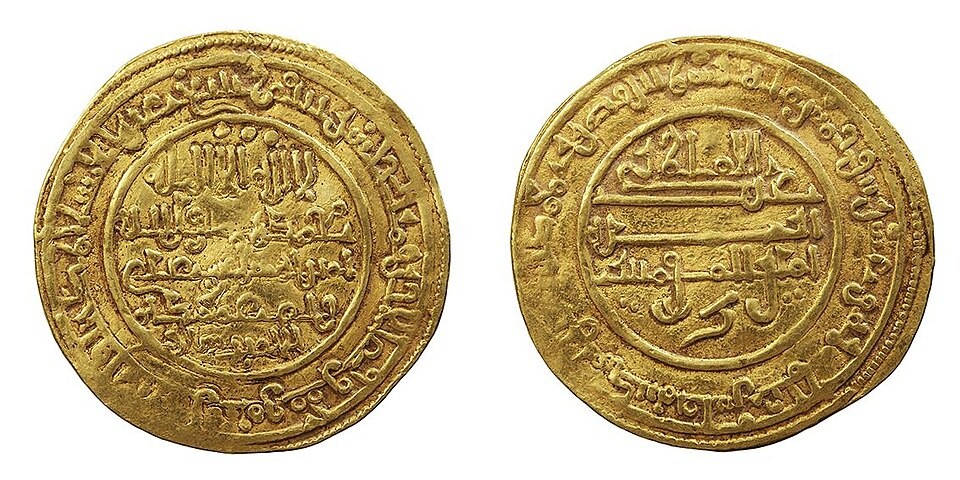

The Almoravids: North Africa and al-Andalus
In the eleventh and twelfth centuries, Almoravid power united much of the western Maghreb and al-Andalus. Mints on both sides of the strait struck dinars. The illustrated Fez issue of Ali ibn Yusuf bears AH 528. The Almería examples documented at Algeria’s National Museum of Antiquities show how dates, mint names, titles and dynastic names were arranged between centre and margin. [18] [19]
Almoravid dinars travelled beyond their issuers’ territories. Their dynastic name became familiar enough in Christian Iberian kingdoms to produce forms such as morabitino, marabotin and maravedi. A coin carried both its issuer’s political history and the linguistic history of people who adopted it. [19] [20]
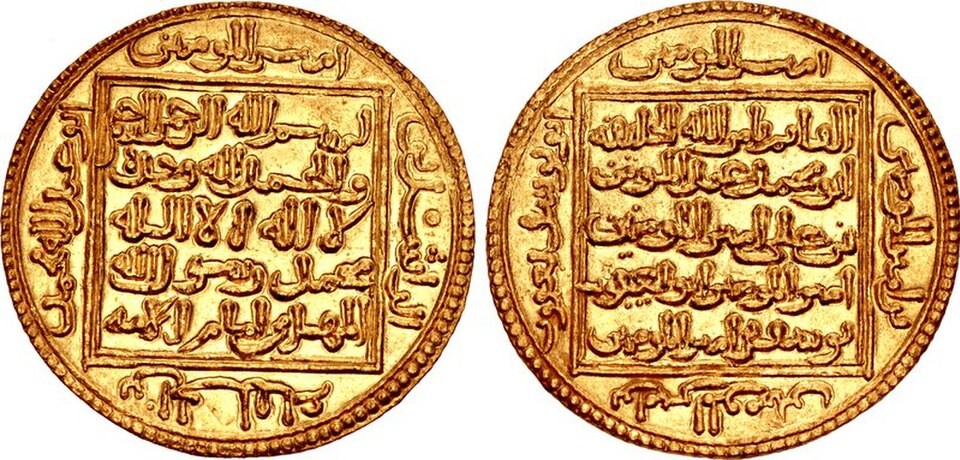

The Almohads change the composition
A square field within a round gold coin became a recognisable Almohad signature. It must not be confused with their square silver dirhams. Catalogues differ in their terminology for values and multiples. The illustrated object is catalogued as a dinar weighing 4.64 grams; that describes this specimen, rather than a universal Almohad weight.
Marinid, Hafsid and other Maghrebi rulers continued these histories with their own titles and production centres. Ibn Battuta’s fourteenth-century travels belonged to a world in which coins carried the names of Fez’s Marinid rulers. Behind “dinar”, there is always a date, a mint and an authority. [23] [38]
Coins cross the boundaries of faith
A gold coin attributed to Offa of Mercia, an eighth-century Anglo-Saxon king, brings Latin and Arabic face to face. It imitates an Abbasid dinar dated AH 157 / 773–774 and adds OFFA REX, inverted in relation to the Arabic. The British Museum object shows the influence of a monetary model beyond its political home. [20]
It does not prove that Offa converted to Islam. Its intended use remains debated: trade, a gift or a particular payment are hypotheses. The copied date belongs to the model and does not establish the imitation’s exact production date. Keeping these questions open is more illuminating than inventing certainty.
Sicily and Iberia: adopting a familiar model
Norman rulers in Sicily continued to strike tarì in the tradition of earlier quarter-dinars. Their coinage could combine languages and traditions of sovereignty. In Iberia, Alfonso VIII of Castile struck gold morabitinos. A monetary design could be adopted for familiarity and usefulness without embracing the entire political or religious world that produced it. [20] [39]
In the Balkans, the dinar is silver
The National Bank of Serbia records a first documentary mention of the Serbian dinar in late 1214; the earliest royal issues are attributed to Radoslav, who ruled from 1227 to 1234. A written reference and the earliest surviving coinage are different kinds of evidence. [21]
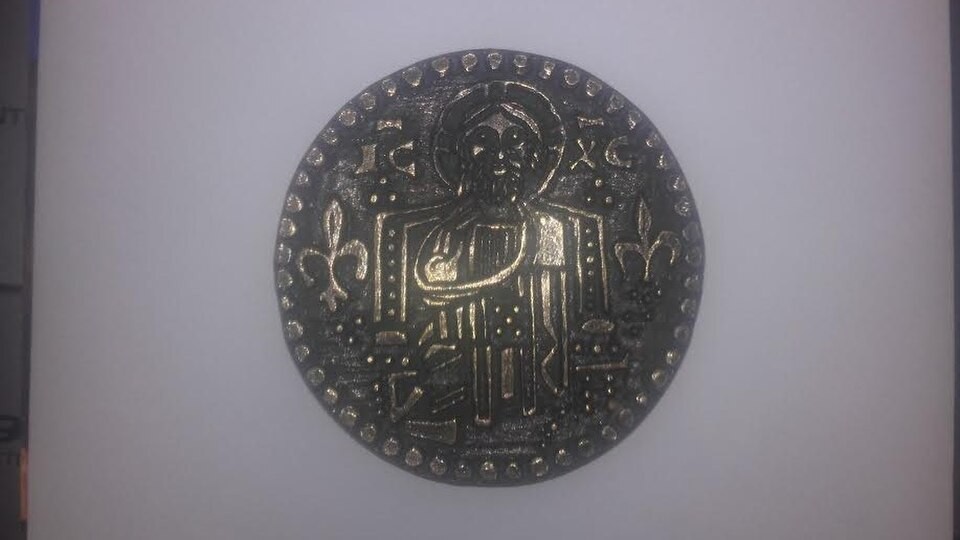

These silver coins belonged to Balkan and Adriatic trade, with Byzantine and Venetian influences. Christ, a patron saint and the ruler might appear on their faces. Mines and mints at Brskovo, Rudnik and Novo Brdo formed part of the story. Under Dušan in the fourteenth century, coinage expressed Serbian power. The fall of the despotate in 1459 ended this medieval tradition. Its name would return much later within a different system. [21]
The dinar does not disappear everywhere at once
No shared decree ended the dinar throughout the Islamic world in the early modern period. Regional systems changed differently. Gold, silver and copper acquired new forms and names, while units of account could survive the coins from which they had taken their names.
In Iran, the dinar notably became an accounting unit detached from the old gold coin. A document reckoning in dinars need not describe the object found in a catalogue of Umayyad gold. Monetary words are tools for calculation as well as names for cash. [4]
New references for gold
From the late fifteenth century, the Ottoman sultani became part of a new gold landscape. Ashmolean records preserve issues naming a sultan and a mint. Arabic inscriptions did not make these unchanged descendants of Umayyad dinars: weights, institutions and trading networks had altered. [22] [40]
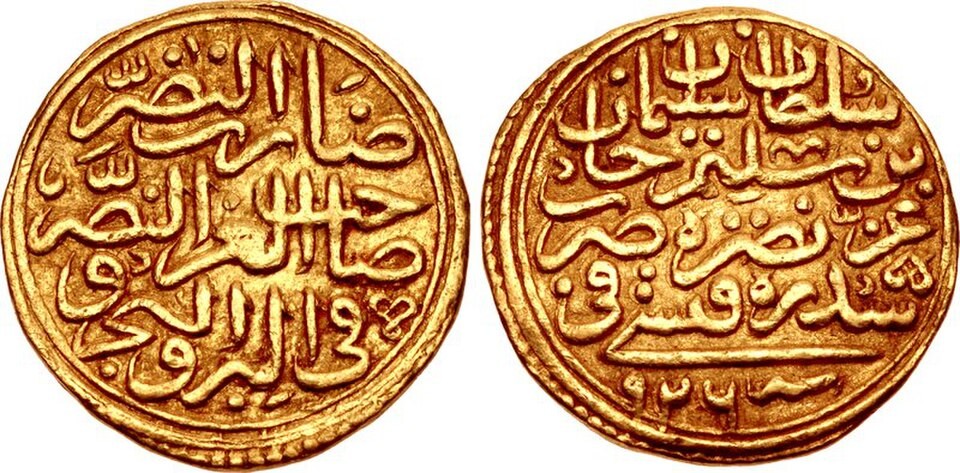

The illustrated coin was struck at Sidrekapsi; it is different from the Egyptian Ashmolean specimen cited as a comparison. The Maghreb also followed several paths. Tunis’s Money Museum presents Hafsid, Ottoman and Husaynid issues, then systems dominated by the riyal and franc. Tunisia’s national dinar of 1958 did not directly replace a medieval coin that had somehow remained in circulation until then. [23]
The name retained prestige and memory. Its new functions would be organised by modern states, monetary laws and issuing banks.
An old name returns in the age of states and banks
In the nineteenth century, monetary unification became part of state building. Foreign coins circulated widely; a national unit could name prices, organise public payments and make sovereignty tangible. Rulers, arms and denominations gave these ambitions a visible form.
Serbia: three stages to distinguish
New Serbian copper coins were struck in 1868. This was not the date of the first modern one-dinar coin. A law of 1873 established the dinar as the national unit; the corresponding first silver coins were minted in 1875. The legal and material stages followed one another. [24]
The chosen name recalled a medieval tradition, but the organisation was contemporary. The dinar was divided into one hundred paras, with metals and values regulated by the state. This was historical reuse, not the reawakening of a fifteenth-century monetary system.
In 1884, the kingdom’s National Bank began operations and issued a gold-payable 100-dinar note. Paper introduced a different representation of trust: its material value was small, its institutional promise important. Early issues were made abroad. National money also tells an international history of manufacturing, contracts and technical collaboration. [25]
The First World War transformed territories and institutions. After it, the Kingdom of Serbs, Croats and Slovenes opened a new monetary space. The dinar kept its name and later became Yugoslavia’s currency. It was no longer simply the pre-war Serbian kingdom’s unit. [33]
The new dinars: choosing an inheritance, creating a currency
In the twentieth century, several countries adopted dinar as the name of a national currency. The decisions were neither simultaneous nor directed by a common authority. Iraq introduced its dinar in 1932, after Indian rupees had become established during the British presence. A currency board preceded subsequent institutional reorganisations. The name evoked a regional inheritance, but the legal framework and banknotes were modern. [26]

Jordan’s dinar entered circulation on 1 July 1950, replacing the Palestine pound, whose use in the kingdom ended on 30 September. Political independence in 1946 and monetary change were distinct stages. [27]
Independence, names and different calendars
Tunisia introduced its dinar in 1958 alongside the establishment of its central bank. Algeria’s first dinar series appeared in 1964, two years after independence. Landscapes, animals, crafts and work on early Algerian notes made people and territory the subjects of a new currency. [23] [30]
Kuwait’s first dinar entered circulation on 1 April 1961, before independence in June. Bahrain adopted its currency in 1965, before independence in 1971. Both histories were connected to earlier rupee circulation and Gulf networks, but their transitions were distinct national projects. [29] [31]
Libya followed another path. In 1971, legislation replaced the names “pound” and “millieme” with “dinar” and “dirham” while keeping their value. This was a legal renaming, not a conversion that multiplied or divided people’s holdings. [32]
These dates mark a family of choices, not a monetary union. The same word can express shared memory while naming currencies with separate issuers, territories and legal histories.
| Country and code | Foundation | Legal subdivision | Earlier currency or transition |
|---|---|---|---|
| Algeria · DZD | 1964 | 100 centimes | Algerian franc [30] |
| Tunisia · TND | 1958 | 1,000 millimes | Tunisian franc [23] |
| Libya · LYD | 1971 | 1,000 dirhams | Libyan pound renamed at parity [32] |
| Jordan · JOD | 1950 | 1,000 fils / 100 qirsh | Palestine pound [27] |
| Kuwait · KWD | 1961 | 1,000 fils | Rupee circulation in the Gulf [29] |
| Bahrain · BHD | 1965 | 1,000 fils | Gulf rupee [31] |
| Iraq · IQD | 1932 | 1,000 fils | Indian rupee [26] |
| Serbia · RSD | 1873 / 2003 | 100 paras | Modern unit founded in 1873; Serbian issuer since 2003 [24] |
A legal subdivision does not mean every small denomination circulates in practice. The two Serbian dates distinguish the foundation of the modern unit from issues bearing the current National Bank of Serbia’s name. This table contains no exchange rates.
Discontinued dinars leave banknotes and memories
The Yugoslav dinar passed through a monarchy, a socialist federation and a reduced federal state comprising Serbia and Montenegro. A lasting name can suggest stability, but changes of issuer, definition and design show a disrupted history. “Yugoslavia” must always be read with its date: both territory and political system changed. [33]
Socialist notes showed work, productive installations and cultural figures rather than the old royal world. Political change became visible on paper. Yet a portrait could survive several reforms; a repeated image did not prove that the unit had remained unchanged.
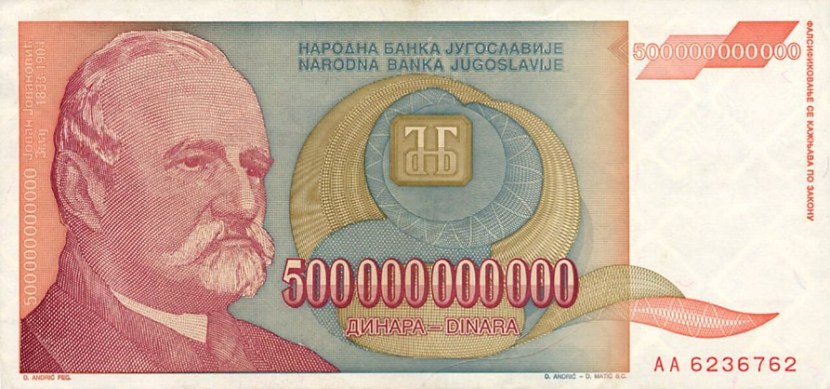

When zeros fill the banknote
The 500-billion-dinar note dated 1993, portraying the poet Jovan Jovanović Zmaj, is material evidence of hyperinflation. Its significance lies beyond the spectacular number. Vast denominations record difficulties in paying for purchases and preserving the value of income. Household life was affected. The new dinar of 1994 belonged to the subsequent stabilisation effort; it did not restore earlier losses. [41] [36]
A name branches into different histories
The breakup of the Yugoslav monetary area led to different choices. Croatia used a temporary dinar from 1991 before adopting the kuna in 1994. Macedonia, now North Macedonia, introduced the denar in April 1992. Its name is related, but MKD identifies a distinct currency. It is discussed here as a neighbouring history, not silently counted as a ninth national dinar. Serbian central-bank issues began in 2003 after those of the National Bank of Yugoslavia. [34] [35] [33]
A map of names is not a map of currencies. Some dinars disappeared, others were recreated, and a denar continues with a different spelling. As in Antiquity, a persistent word does not remove the need to examine institutional breaks.
Eight currencies, several ways to tell a country’s story
From Algeria to Iraq and the Gulf to Serbia, these eight dinars share a name. They are not interchangeable and are not defined by a common quantity of gold. Their value does not derive from the weight of a medieval coin. Subdivisions also differ: centimes and paras, millimes, fils and dirhams. Even “dirham” can mean a subdivision here and a whole currency elsewhere.
A modern note combines denomination, issuing bank, signatures, date or issue type, security devices and imagery. It is this combination that identifies it. A portrait alone is insufficient, since several generations can reuse a cultural figure.
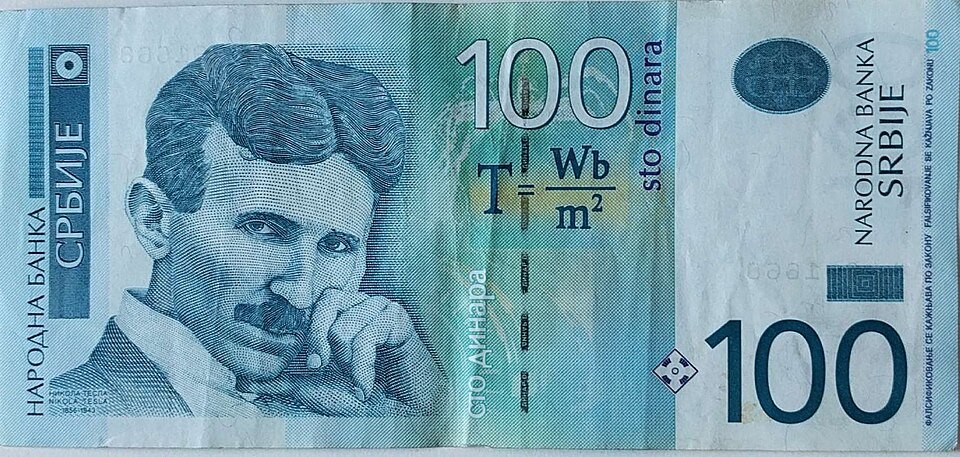

From royal titles to national heritage
Serbia’s 100-dinar note places Nikola Tesla at the centre of a tribute to science. A formula recalls the unit of magnetic induction named after him. This associates money with scientific achievement rather than only a head of state. Tesla appeared on Yugoslav and Serbian issues, crossing different institutional settings. The photograph illustrates a type; it does not establish an unreadable specimen date. [36]
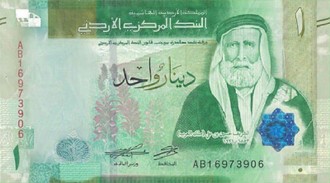

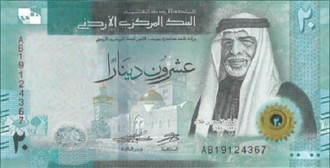

Jordan’s fifth issue offers another answer. Hashemite portraits establish a dynastic memory, alongside plants, animals and other national motifs. Its one-dinar note entered circulation on 26 December 2022; the twenty-dinar note followed on 21 March 2023. A series date must not automatically be assigned as the launch date of every denomination. These reduced, single-face reproductions remain subject to the documented Jordanian conditions. [37]
The contrast with medieval gold is striking, but should not become a false opposition. Early Islamic coinage included human figures. Contemporary paper is not the universal return of an image absent everywhere for thirteen centuries: media, institutions and intentions have changed.
The journey ends with this plurality. Republican Rome supplied a name whose descendants followed several paths. Caliphates made gold dinars instruments of power and exchange. Medieval rulers adapted them, early modern systems changed their roles, and contemporary states gave them new existences. Coins and notes retain the traces of these decisions. Looking closely is how we hear the long history of a name.
The eight national dossiers develop the Algerian, Bahraini, Iraqi, Jordanian, Kuwaiti, Libyan, Serbian and Tunisian stories. This shared account explains connections and origins; it is not an issue-by-issue catalogue of each country.
A few keys to reading coins
- Obverse / reverse
- The two sides of a coin, named according to the conventions of its series and catalogue.
- Mint
- The place where a coin was struck, sometimes named on the object and sometimes attributed.
- Epigraphic
- A design composed principally of inscriptions.
- Flan / die
- The metal blank to be struck / the engraved tool transferring the design.
- Fineness
- The proportion of precious metal in an alloy, distinct from its total weight.
- Unit of account
- The unit in which an amount is expressed; it need not correspond to an identical physical coin.
- AH
- Anno Hegirae, the Islamic lunar calendar; a year generally overlaps two civil years.
Sources and further reading
Numbered references link to the records below. Each image has a separate source, credit and reuse status. Research checked on 15 October 2026. Original publication titles are retained; uncertain attributions are identified in the narrative.
- Andrew Burnett, The Roman Provinces, 300 BCE–300 CE, extrait, chapitre « Precious Metal Coinages »Context and dating of the denarius reform.
- Jonathan R. Wood, Matthew Ponting et Kevin Butcher, Mints not Mines: a macroscale investigation of Roman silver coinage, Internet Archaeology 61 (2023), dépôt UCLChanges in Roman silver coinage.
- Dictionnaire de l’Académie française, « denier »The Latin name in French.
- Philippe Gignoux et Michael L. Bates, « Dinar », Encyclopaedia IranicaEastern history of the word, the reform and units of account.
- Metropolitan Museum, Gold Solidus of Constans II, 04.35.3355Byzantine gold: imagery and fiscal functions.
- Nikolaus Schindel, « Sasanian Coinage », Encyclopaedia IranicaDrachms, portraits, reverse designs and the role of gold.
- Michael L. Bates, « Arab-Sasanian Coins », Encyclopaedia IranicaTransitional issues and retained earlier types.
- Metropolitan Museum, Dinar, 79 AH / 698–99 CE, 99.35.2386The illustrated Umayyad specimen and the epigraphic reform.
- Metropolitan Museum, Abd al Malik ibn Marwan, Byzantium and IslamThe caliph and transitional figural designs.
- Metropolitan Museum, Masterpieces from the Department of Islamic Art, notices monétairesInscriptions and the limits of mint attribution.
- Metropolitan Museum, Coin, 164 AH / 780 CE, 39.40.127.556The illustrated dinar of al-Mahdi.
- Metropolitan Museum, The Art of the Abbasid Period (750–1258)Baghdad and Abbasid power.
- Metropolitan Museum, Rare Coins from NishapurNames, mints and political hierarchies.
- Metropolitan Museum, The Art of the Fatimid Period (909–1171)North Africa, Egypt, Cairo and trade networks.
- Bibliotheca Alexandrina, Antiquities Museum, dinar d’al-Mustansir, Alexandrie, 435 HAn Alexandrian specimen contemporary with the illustrated type; a different object.
- Metropolitan Museum, Jerusalem 1000–1400: Every People Under Heaven, catalogueGeniza documents, dowries and settlements in dinars.
- Metropolitan Museum, The Trans-Saharan Gold Trade (7th–14th Century)Gold routes and African political powers.
- Ali Benbella, Musée national des antiquités d’Alger / Museum With No Frontiers, dinar II.N.268Almería dinar, AH 537: inscriptions and mint.
- Musée de Bank Al-Maghrib, Les super-héros du MuséeAlmoravid gold, marabotins and Maghrebi dynasties.
- British Museum, Money Gallery, Room 68, guide de la collectionOffa, Castilian morabitinos and international circulation.
- Banque nationale de Serbie, History of money in SerbiaThe reference of 1214, Radoslav, mining and the end of medieval coinage.
- Ashmolean Museum, Heberden Coin Room, HCR17016An Egyptian sultani of Suleiman, AH 943; a different reference specimen.
- Banque centrale de Tunisie, Musée de la monnaie, CollectionsHafsids, early modern currencies and the dinar of 1958.
- Banque nationale de Serbie, 150 years of the Serbian dinarThe law of 1873, distinguished from coinage in 1868 and 1875.
- Banque nationale de Serbie, 140 ans de la Banque nationaleThe bank’s operations began in 1884.
- Banque centrale d’Irak, نبذة عن نشأة العملة العراقيةRupees, the currency board and the dinar of 1932.
- Banque centrale de Jordanie, IntroductionsThe dinar in 1950 and the chronology of note issues.
- Banque centrale du Koweït, Introduction — banknotes and coinsCurrency unit and subdivision into fils.
- Banque centrale du Koweït, First IssueFirst circulation on 1 April 1961.
- Banque d’Algérie, Les premiers billets de l’Algérie indépendanteThe first Algerian dinar series, 1964.
- Banque centrale de Bahreïn, Annual Report 2016The first dinar of 1965 commemorated.
- Libye, loi no 63 de 1971 modifiant la loi bancaire, transcription du texteRenaming at equal value, effective on 1 September 1971.
- Banque nationale de Serbie, History of money in Serbia, sections modernesYugoslav institutions and Serbian issues from 2003.
- Banque nationale de Croatie, Numismatic Issues 1994–2014The temporary dinar of 1991 and kuna of 1994.
- Banque des règlements internationaux, discours de la gouverneure Anita Angelovska Bezhoska, 30 years of monetary independenceMacedonian monetary independence and the denar in 1992.
- Banque nationale de Serbie, hommage à Nikola Tesla, actualité no 19053Tesla on Yugoslav and Serbian issues; the new dinar of 1994.
- Banque centrale de Jordanie, chronologie de la cinquième émissionOne dinar: December 2022; twenty dinars: March 2023.
- Musée de Bank Al-Maghrib, À la découverte du grand périple d’Ibn BattûtaMarinid coinage in fourteenth-century Fez.
- British Museum, Gold 1/4 dinar and a tari of Roger II, notice sur Google Arts & CultureFatimid quarter-dinars and Norman tarì.
- Stephen Album, A Checklist of Islamic Coins, 3e édition, 2011Numismatic terminology and Ottoman sultani.
- Society of Paper Money Collectors, Paper Money, juillet–août 2015, no 298, « Many Yugoslavian notes reflect extreme inflation »The 500-billion note of 1993 and reforms in 1994.