Tunisia’s money tells more than a sequence of values. It carries the horses of Carthage, the names of rulers, promises of redemption and the faces of a shared heritage.
01Carthage: the horse before the dinar
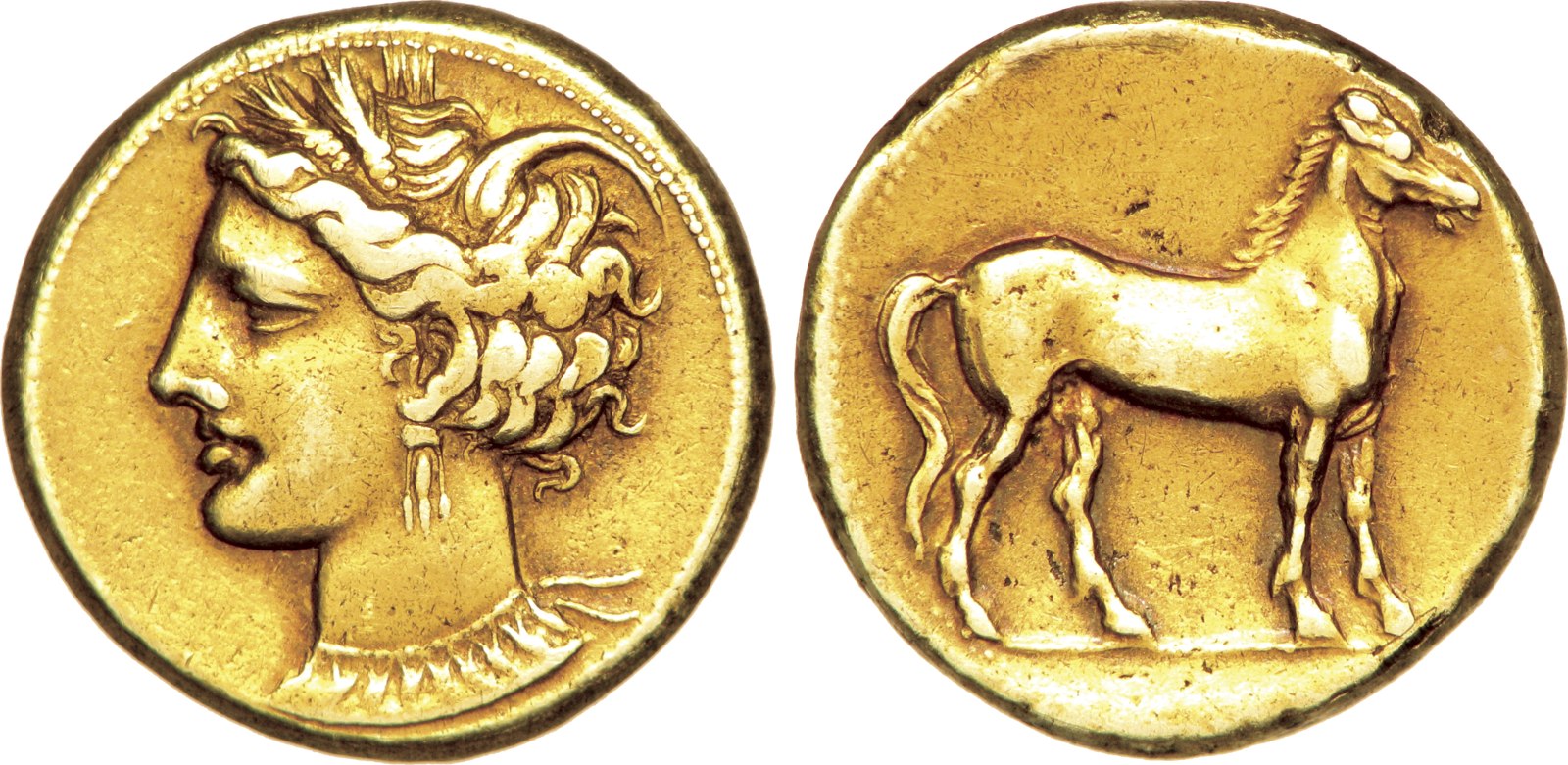
A standing horse and a female head crowned with grain: on a few grams of electrum, Carthage left an image that remains recognisable more than twenty-three centuries later. This is neither a securely identified portrait of Hannibal nor an early Tunisian dinar. It belongs to a different monetary world, shaped by Mediterranean cities, armies and trade.
Carthaginian coinage first emerged in the Sicilian setting in the late fifth century BCE, in connection with military expenditure and the payment of mercenaries. Minting subsequently developed on African soil. The history of issuing coins should be distinguished from the much older history of exchange: a trading power could conduct extensive commerce before striking a currency of its own.
The illustrated stater, dated around 310–290 BCE in its catalogue record, combines two recurring themes. Its female deity is traditionally identified as Tanit, though the visual language also draws on Greek art and representations of Kore or Persephone. The horse occupies the other face. Images travelled alongside precious metals. The Metropolitan Museum holds another Carthaginian stater dated 310–270 BCE, a reminder that these are scholarly date ranges rather than years engraved on every specimen.
Electrum is an alloy of gold and silver. Its shine alone could not determine its value: weight, composition and confidence in the issuing authority all mattered. Small bronze coins, less dazzling in a display case, are equally important evidence for ordinary payments. A history built entirely around gold would leave much of monetary life out of view.

02Rome, the Vandals and Byzantium: a mint with many lives
Rome’s destruction of Carthage in 146 BCE marked a decisive political break. It did not mean that every coin already in use vanished on the same day. For a numismatist, the date of a conquest and the working life of an object are separate questions. Numidian coins, local bronzes and imperial issues make for a more gradual history than a sequence of rulers might suggest.
Within the Roman Empire, the ruler’s portrait, official titles and reverse designs gave coins a public role. They announced authority, celebrated victories and offered images of imperial order. The African province participated in this wider circulation while retaining its own cities, networks and local practices.
Following the Vandal conquest of 439 and Byzantine reconquest in 533, Carthage remained an important monetary centre. A bronze follis of Justinian I in the Kelsey Museum, struck at Carthage in 539–540, pairs a frontal imperial portrait with a large M. The M is a Greek numeral indicating forty nummi. Reading a coin can therefore require recognising a number rather than an initial.
The gold solidus served different purposes from small bronze denominations. Research on metal composition published by the American Numismatic Society also shows that a mint’s history can be traced through its alloys as well as its imagery. None of this establishes an unbroken chain of monetary value between ancient African coinage and today’s dinar: these were distinct systems, with different standards and institutions.
03The medieval dinar: writing becomes an image
Islamic rule introduced a new monetary vocabulary to Ifriqiya: the dinar for gold, dirham for silver, and fals—plural fulus—for small copper money. The word dinar belongs to the long linguistic family of the Latin denarius. That relationship of names should not be mistaken for continuity in weight, metal content or purchasing power.
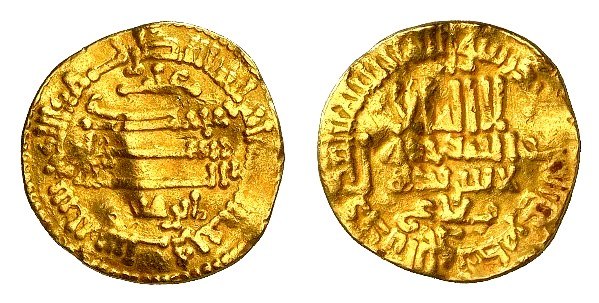
On the illustrated Aghlabid dinar, struck in AH 286, corresponding to 899 CE, lines of script occupy both the centre and the surrounding margin. Its record attributes it to the reign of Ibrahim II and identifies the mint official Ballagh. The object thus supplies a date, an issuing ruler and a trace of monetary administration. The inscription is also its design: reading and looking become part of the same activity.
Later dynasties rearranged the formulas and their composition. Concentric layouts on Fatimid issues and framed designs in the Almohad and Hafsid traditions transformed the surface of the coin. The ruler’s name and religious references could proclaim legitimacy as effectively as a portrait did elsewhere.
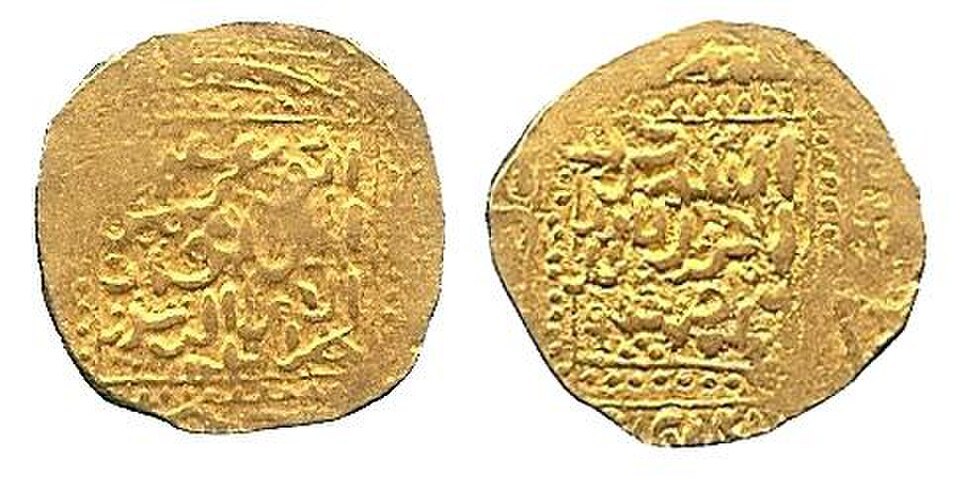
The illustrated Hafsid dinar of Abu Amr Uthman belongs to the fifteenth century. Its catalogue record identifies Tripoli as the mint. This distinction matters: it represents the wider political and commercial world of the Hafsids, centred on Tunis, but is not a coin struck in Tunis. Historical Ifriqiya extended beyond Tunisia’s present borders. Projecting those borders backwards would obscure the geography that these coins actually document.


04The beys and the paper-money experiment of 1847
In the Regency of Tunis, accounts and payments operated within a world of rials, also called piastres, and smaller subdivisions. Foreign coins circulated through Mediterranean trade as well. The Husaynid dynasty, founded in 1705, developed its own issues. Controlling money meant trying to manage revenues, payments and the ruler’s position within commercial exchange.
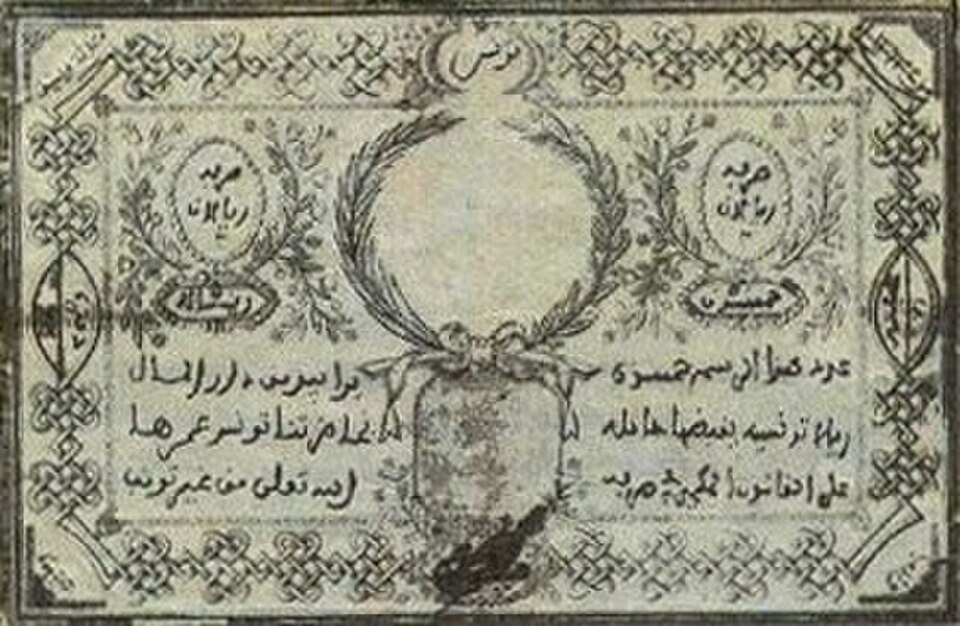
Ahmed Bey, who ruled from 1837 to 1855, pursued military and administrative reforms. The experiment of 1847 introduced a different instrument: Tunisian paper money. An establishment known as Dar al-Mal was intended to provide exchange between notes and metallic currency. The fifty-rial note, also described as fifty piastres, is therefore neither a colonial franc nor an early version of the fifty-dinar banknote.
Its layout deserves close attention. Cartouches, dense lettering, ornament and authentication marks organise the paper. Drawing on Tunisian National Archives material, Faiza Guesmi’s research examines its seals, Mustapha Khaznadar’s signature and the promise of redemption. It also records a deduction of four per cent when the paper was exchanged for coin. Confidence rested on written undertakings, visible validation and a redemption procedure.
The experiment did not establish a lasting paper currency. The promise printed on a note depended on the institution’s ability to supply metal and on the trust it commanded. Yet the financial difficulties of the beylical state cannot be reduced to the failure of a single issue: costly reforms, borrowing and external pressures were intertwined. The surviving paper remains a striking witness to a locally initiated attempt at monetary modernisation.

05The Tunisian franc: money in two scripts
The French protectorate was established in 1881. The monetary reform of 1891, ten years later, introduced the franc within a system modelled on France’s. The establishment of the protectorate and the replacement of the rial should therefore not be treated as the same event.
Tunisian franc coins are bilingual objects. One face could carry the bey’s Arabic titles and an Islamic date; the other displayed “Tunisie”, a value in francs or centimes and a Gregorian year. A gold ten-franc piece dated 1891 in the Paris Musées collection provides a material landmark. Such coins combine the symbolic survival of beylical authority with integration into the protectorate’s monetary arrangements.
Manufacture supplies another clue: the new series were struck in Paris. The issuing territory, the country name on a coin and its place of production need not be identical. Engravers prepared models and dies; a mint then reproduced the design on metal blanks. The adoption of the franc involved manufacturing and supply as well as changes in accounting language.
Paper money followed a history of its own. In 1904, the Banque de l’Algérie received an issuing privilege in the regency. Some issues bore a “Tunisie” overprint identifying their territorial destination. This was not an overprint converting francs into dinars. The later name Banque de l’Algérie et de la Tunisie belongs to the subsequent history of the issuing institution.
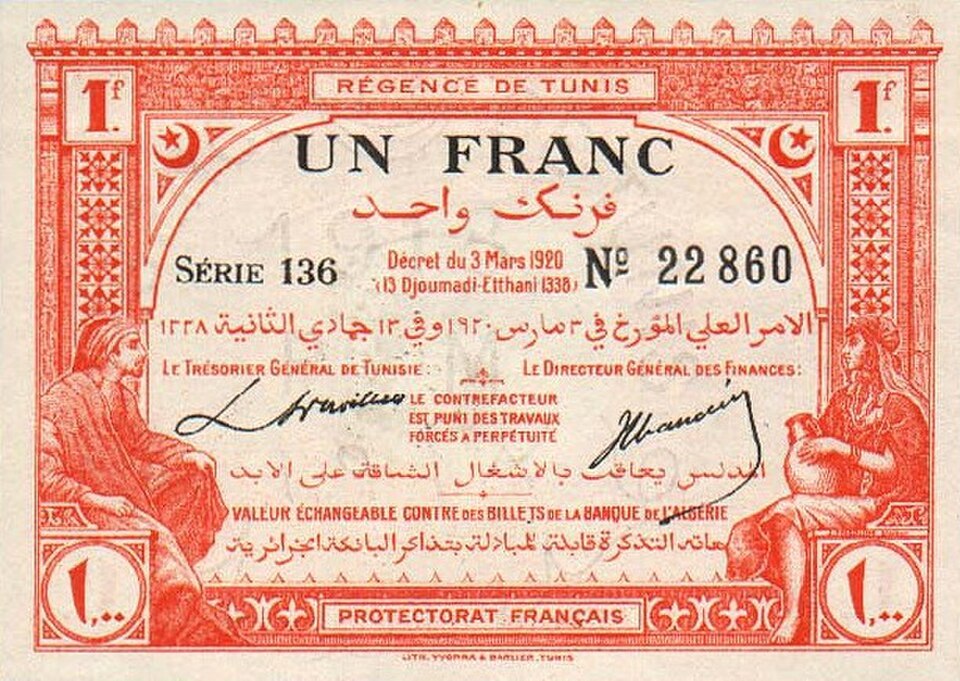
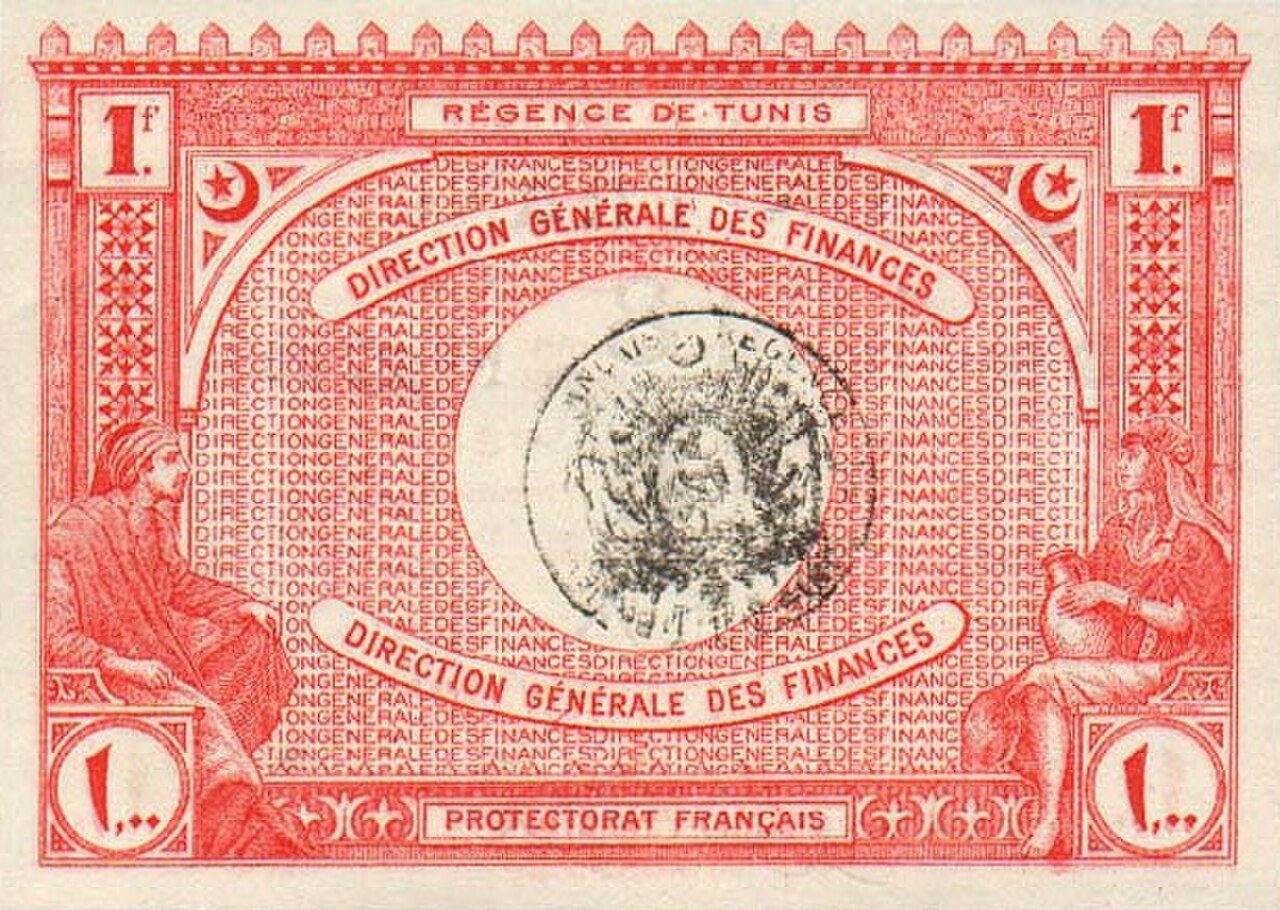
The small one-franc note of 1920 shown here belongs to another category. Bearing the name Régence de Tunis, it was a low-value issue associated with the need for small change. Paper could step in when sufficient coin was unavailable. Its modest denomination is precisely what makes it valuable evidence: monetary history includes the change returned after a purchase, as well as large notes issued by banks.


061958: establishing the dinar and managing the transition
Independence on 20 March 1956 and the proclamation of the republic on 25 July 1957 preceded the new currency. Monetary autonomy required several steps: an institution, a conversion law, banknotes and an exchange mechanism. Dating the dinar to 1956 would erase that process.
The law of 19 September 1958 created the Central Bank of Tunisia. Law No. 58-109 of 18 October established the dinar, divided into one thousand millimes. Article 4 required obligations to be expressed in dinars from 1 November 1958. The central bank began operating and new notes entered circulation on 3 November. These dates answer different questions: the unit used for contracts on one hand, institutional operations and the circulation of cash on the other.
1 dinar = 1,000 Tunisian francs = 1,000 millimes. A debt of 12,500 old francs became 12.500 dinars: twelve dinars and five hundred millimes. The numerical scale changed; conversion alone did not multiply anyone’s wealth.
The legislation provided for continuity. Notes of the Banque de l’Algérie et de la Tunisie temporarily retained legal-tender status before withdrawal. They were to be exchanged without charge for central-bank notes at the prescribed ratio. Existing franc coins were not all replaced immediately: the law arranged for their assumption by the central bank and related old denominations to millimes. The reform was much more than printing a new currency name.
The first banknotes were for half a dinar, one dinar and five dinars. Hédi Nouira, the first central-bank governor, played a central role in establishing the issuing institution. Bourguiba’s portrait asserted republican sovereignty, while buildings and monuments supplied the new money with a national landscape.
A further decision followed at the end of 1958: Tunisia did not follow the devaluation of the French franc. A World Bank economic report distinguishes December’s exchange-rate decision from November’s conversion and the trade arrangements that followed. The dinar’s birth should therefore be understood neither as simply removing three zeros nor as a separation completed in a single day.
07A thousand millimes: money in the hand
The dinar has a readily visible feature: it is divided into one thousand units. A millime is one thousandth of a dinar, not one hundredth. Prices can consequently use three decimal places: 2.350 dinars means two dinars and three hundred and fifty millimes. English-language catalogues also use the spelling “milim”.
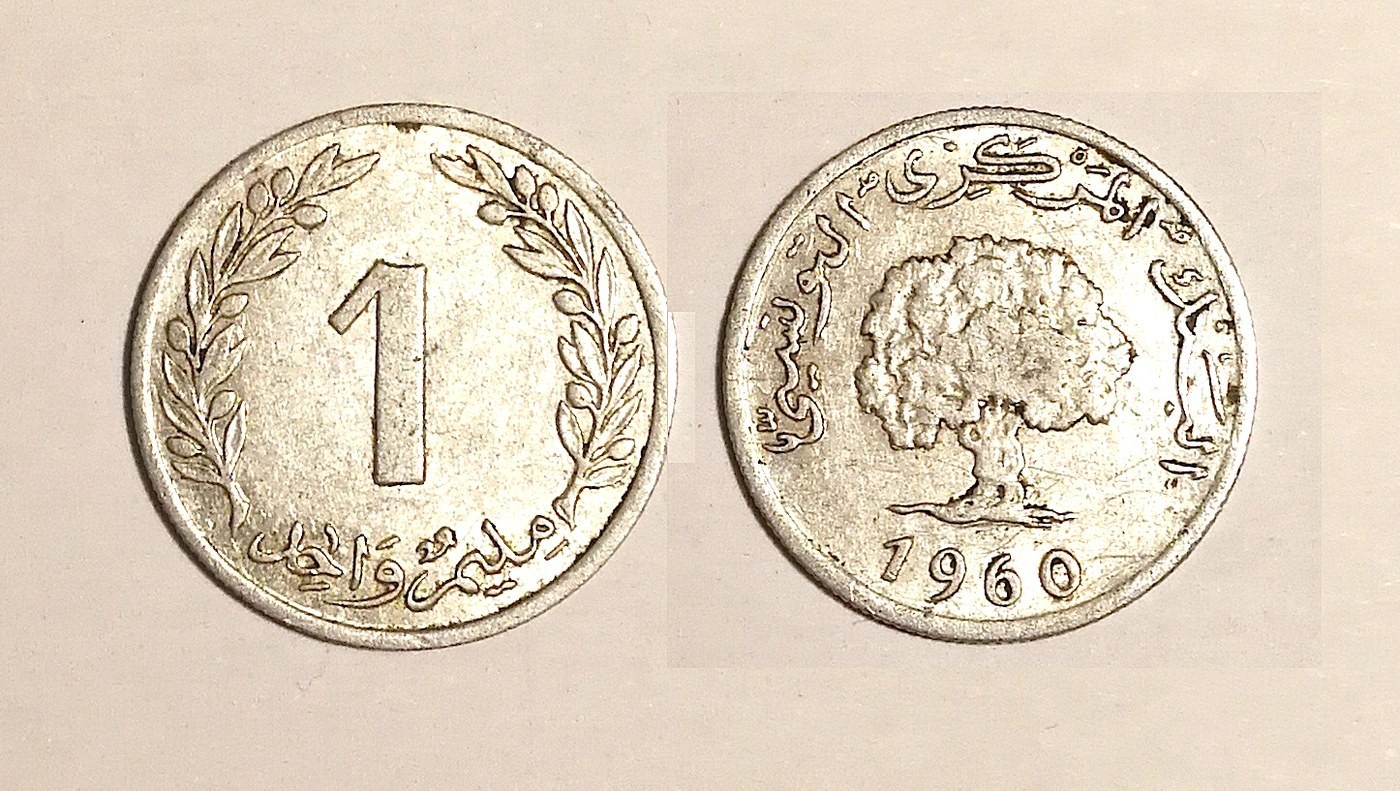
Small coins dated 1960 make this numerical system tangible. The illustrated one-millime piece is aluminium; it presents its denomination and republican imagery in an object intended for repeated payments. These photographs are enlarged for reading, so the relative sizes on the page should not be mistaken for a life-size comparison.
The gradual transfer of some low denominations from paper to metal reflects different practical requirements. A note folds and wears; a coin tolerates repeated handling but adds weight to a pocket. For a collector, a half-dinar note and a half-dinar coin are consequently not redundant objects. They document different moments and technical solutions.
Circulating money should also be distinguished from precious-metal commemorative issues. An inscribed face value tells us neither a collector’s market price nor whether an object was commonly used for shopping. Special issues can record an anniversary; ordinary coins preserve evidence of repeated everyday gestures. Both belong in monetary history, but they answer different questions.

08From a presidential portrait to a wider public memory
During the republic’s early decades, Bourguiba occupied a central place on banknotes. His portrait appeared alongside buildings, infrastructure and activities that shaped the image of an independent country. That visual proximity was purposeful: a note identified its issuer while presenting a view of the territory and its ambitions.
Later series widened the historical gallery. Hannibal, Ibn Khaldun and Dido introduced different timescales into paper money. A name might invoke an established historical life, an intellectual achievement or a foundation tradition. Dido, also called Elissa, belongs to the traditional account of Carthage’s foundation. Her banknote image should not be described as an authentic likeness surviving from antiquity.
Placing someone on a banknote is a choice about public memory. It does not turn a modern image of Hannibal into ancient evidence, nor an imagined portrait into a verified resemblance. Likewise, a series can change its principal figures without changing the monetary unit. The dinar remains the dinar across successive design programmes and political periods.
Comparing these notes invites precise questions. Who is named? Which monument accompanies the portrait? How are Arabic, French and numerals arranged? National history is conveyed through a selection of images handled by millions of people who may rarely stop to examine them. The gallery is also an invitation to recover the lives and works behind familiar faces.
092017–2022: four notes, four views of Tunisia
The issues of 2017, 2020 and 2022 form an especially revealing group. Central-bank notices identify their subjects, reverse designs and circulation dates. They allow accurate descriptions without turning this historical selection into an exhaustive list of money currently holding legal-tender status.
20 dinars: Farhat Hached and El Jem
The 2017 type pairs trade union leader Farhat Hached (1914–1952) with the amphitheatre of El Jem. The combination brings the national movement into the same object as a monument of Roman Africa. Although the note bears the date 25 July 2017, it entered circulation on 21 December. The printed date need not be the day a banknote reached people’s wallets.
10 dinars: Tawhida Ben Cheikh
The blue 2020 type honours physician Tawhida Ben Cheikh (1909–2010), a pioneering figure in Tunisian medicine. Pottery and Berber jewellery appear on its reverse. Medicine, craft knowledge and the arts of everyday life join the national gallery. This was not the first female representation in all Tunisian monetary history: Dido had appeared on an earlier note. Its significance includes the recognition of a Tunisian woman from modern history.
Notice No. 2020-16 was signed on 26 March and set the circulation date at 27 March 2020. The note itself bears “20-3-2020”. The central bank’s board had decided on the issue in December 2018, so its design should not be explained as an improvised response to the pandemic of 2020.
5 and 50 dinars: science and the monetary institution
Issued on 28 April 2022, the five-dinar note features agronomist and researcher Slaheddine El Amami (1936–1986), with the Zaghouan aqueduct on the reverse. Water connects an ancient engineering achievement with the concerns of agricultural research. The fifty-dinar note honours Hédi Nouira (1911–1993), the central bank’s first governor and later prime minister. The bank’s headquarters appears on its reverse.
These pairings suggest a cultural reading: health, work, research, heritage and monetary sovereignty offer several ways of telling Tunisia’s story. Such interpretation should follow careful identification of dates and designs. It does not replace the material description of the banknotes themselves.
10From seals to watermarks: the technology of trust
Between the paper issue of 1847 and recent banknotes, authentication changed profoundly. Seals and signatures referred to identifiable authorities; registers, numbers and ornament made imitation more difficult. Modern banknotes add layers of specialised manufacturing to this older logic.
Intaglio printing produces relief that can be felt. A watermark becomes visible through the paper when held to the light; it is not simply a portrait printed in pale grey. A windowed security thread appears intermittently at the surface while showing a continuous line in transmitted light. Special inks and optical devices change appearance when a note is tilted.
The official description of the 2022 fifty-dinar note specifies a RAPID HD thread and a SparkLive element, alongside five horizontal tactile lines intended to assist people with impaired vision. The 2020 ten-dinar note has two such lines. Tactile features form part of the design of something meant to be used, as well as seen.
A photograph records portraits and colours effectively, but cannot reproduce touch, transparency or moving optical effects. Studying reproductions means keeping that limitation in mind. From striking metal to printing paper, the dinar’s history remains a history of material objects whose use depends on manufacture as well as the legal texts establishing them.
11A reading guide to Tunisian monetary history
| Period or date | What changed | A useful distinction |
|---|---|---|
| Late fifth century BCE | Early Carthaginian issues in a Sicilian setting | Long-established trade and the issuing of coins |
| Roman and Byzantine periods | Imperial coinage and the Carthage mint | Gold solidi and small bronze money |
| Middle Ages | Dinars, dirhams and fulus | Shared names and different monetary systems |
| 1847 | Paper issues in rials or piastres | A promise on paper and redemption in coin |
| 1891 | Reform introducing francs | Monetary reform and the protectorate established in 1881 |
| 19 September / 18 October 1958 | Central bank established / monetary law | The institution and the unit of account |
| 1 / 3 November 1958 | Contracts in dinars / central bank operations and new notes | A legal accounting date and a circulation date |
| 1960 | The small millime coins illustrated here | The dinar’s creation in 1958 and subsequent coin issues |
| 2017 / 2020 / 2022 | New portraits and banknote technology | Inscribed date, design type and circulation date |
Money is a unit of account, a means of payment and a physical object. Its history becomes clearer when those dimensions are kept distinct. The modern dinar has a precise legal beginning; the heritage it draws upon, from Carthage to contemporary medicine, belongs to a much longer history.
Sources and image credits
Local photographs illustrate ancient and medieval coins and historical paper money. Recent issues are described from central-bank notices; their designs are not reproduced because commercial reproduction conditions have not been established. External links lead to references; the narrative and its illustrations remain available offline.
- Musée de la Monnaie · collections
- Metropolitan Museum · stater 52.127.5
- University of Michigan · Coins of Empires
- American Numismatic Society · Studies in Early Byzantine Gold Coinage
- Faiza Guesmi · OMNI 18 (2024), p. 197–216
- Loi n° 58-109 du 18 octobre 1958 · archives Banque mondiale
- Banque mondiale · Tunisie, rapport économique, 1980
- Paris Musées · 10 francs or, Tunisie, 1891
- BCT · note n° 2020-16, 26 mars 2020
- BCT · circulaire n° 2017-11, 20 décembre 2017
- BCT · note n° 2022-15, 28 avril 2022
- BCT · communiqué du 28 avril 2022, reproduit par WMC
- FMI · Finances & Développement, septembre 2020
Full image credits: images-manifest.json. Method and verification: README.