- 13th c.Silver dinars
- 1868Copper returns
- 1873The official dinar
- 1884The first banknote
- 1994Stabilisation
- 2003The NBS signature
01 / 12
Before the dinar: a meeting place of currencies
A collection of Serbian money might place a Roman denarius beside a small medieval silver coin, a prince’s portrait in copper and a banknote worth five hundred billion dinars. These objects record successive monetary worlds rather than the survival of one unchanged system. The name dinar links several periods, but the metals, institutions and territories behind it have changed profoundly.
Long before the first Serbian rulers issued coins, Greek, Macedonian, Roman and later Byzantine money circulated through the Balkans. The Danube served both as a commercial route and a military frontier. Coins travelled with merchants, armies and tax payments. The National Bank of Serbia’s collections include issues of Athens, Philip II of Macedon and Alexander the Great, followed by an extensive Roman collection.
The Roman silver denarius is the linguistic ancestor of the name dinar. That relationship does not mean that a modern dinar can be redeemed for an inherited quantity of Roman silver. It records the movement of a monetary word across languages and civilisations. After Rome, Byzantium left an enduring mark on the Balkans; its imperial and religious imagery also supplied models for early Serbian coinage.
02 / 12
Silver, mines and kings · thirteenth to fifteenth centuries
The National Bank identifies an archival reference to “Serbian dinars” in late 1214, during the reign of Stefan the First-Crowned. It distinguishes this written reference from the earliest coinage securely associated with an issuing ruler: King Radoslav in the first third of the thirteenth century. A date in an archive and a surviving coin provide different kinds of evidence. Keeping them separate avoids presenting 1214 as an entirely documented founding date for a coin series.
The growth of the medieval dinar depended on silver. Mining centres including Brskovo, Rudnik, Novo Brdo and Trepča supplied coin production connected to Balkan and Adriatic trading routes. The metal had to be refined, prepared as blanks and struck between engraved dies. Mines and workshops brought resources, skilled labour and political authority into close contact.
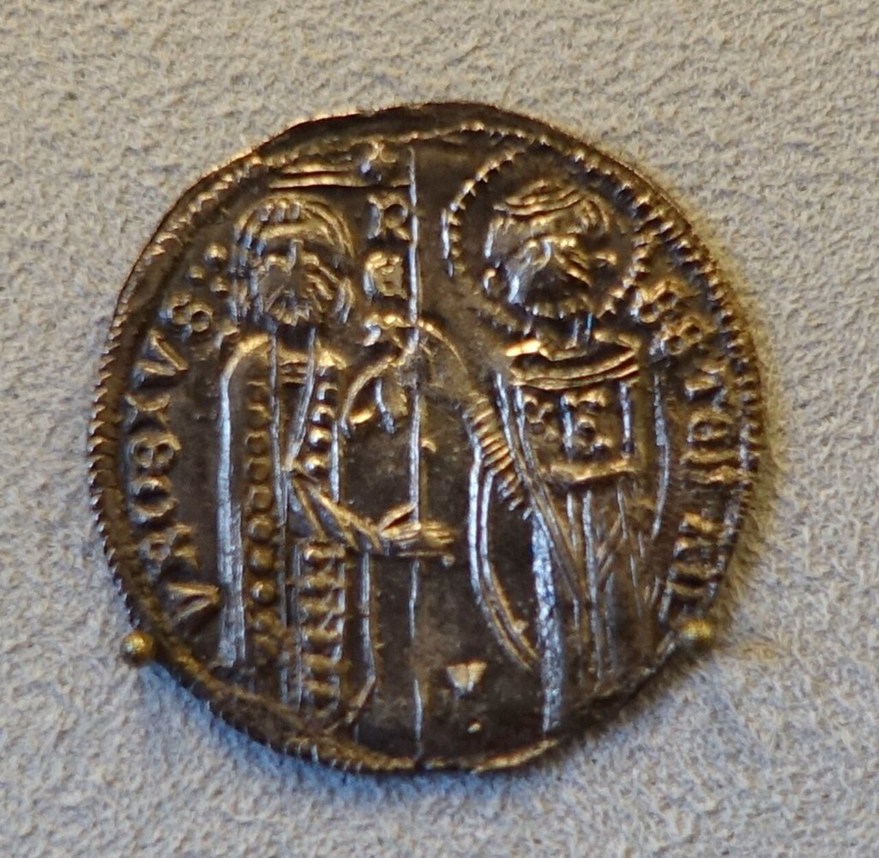

Coin designs spoke the language of authority. A king, saint, cross or enthroned Christ was more than decoration: the image identified the power guaranteeing the coin and placed it within a shared Christian world. The silver dinar of matapan type illustrated here recalls the compositions of Venetian silver grossi. Byzantine and Adriatic influences could coexist, reflecting Serbia’s participation in more than one network.
Under Stefan Dušan, king from 1331 to 1346 and emperor until 1355, issues multiplied and royal titles expressed expanding sovereign ambitions. Later, the fragmentation of political power was reflected in a wider range of issuing authorities. Despots Stefan Lazarević and Đurađ Branković belong to the last major phases of medieval Serbian coinage.
These workshops should not be confined to a present-day national map. Medieval territories, sovereignties and trading connections had their own geography. A coin can belong to Serbian history while having been struck in a city now located in another state. A British Museum record for a coin of Stefan Uroš V minted at Cattaro, modern Kotor, provides a concrete example.
03 / 12
Ottoman currencies and the return of national coinage
The fall of the Serbian Despotate in 1459 marked a major political break. Money naturally remained in use under Ottoman rule, but other authorities organised its issue. Ottoman mints operated at Novo Brdo, Kučajna and Belgrade. Collections also preserve European currencies used in the region. This mixed landscape reminds us that a trading area could use several kinds of coin without having a national currency in the modern sense.
The Ottoman monetary word para survived as the subdivision of the restored dinar: one dinar consists of one hundred para. The names of the unit and its fraction therefore carry different historical inheritances. It is a small but revealing detail in the vocabulary of everyday money.
In the nineteenth century, autonomy and the principality’s growing international standing made it possible to issue money bearing a Serbian ruler’s portrait again. The first step was not a large silver coin. In 1868, copper coins of 1, 5 and 10 para appeared with the portrait of Prince Mihailo Obrenović III. Copper met the needs of small transactions and brought the state’s image into ordinary purchases.
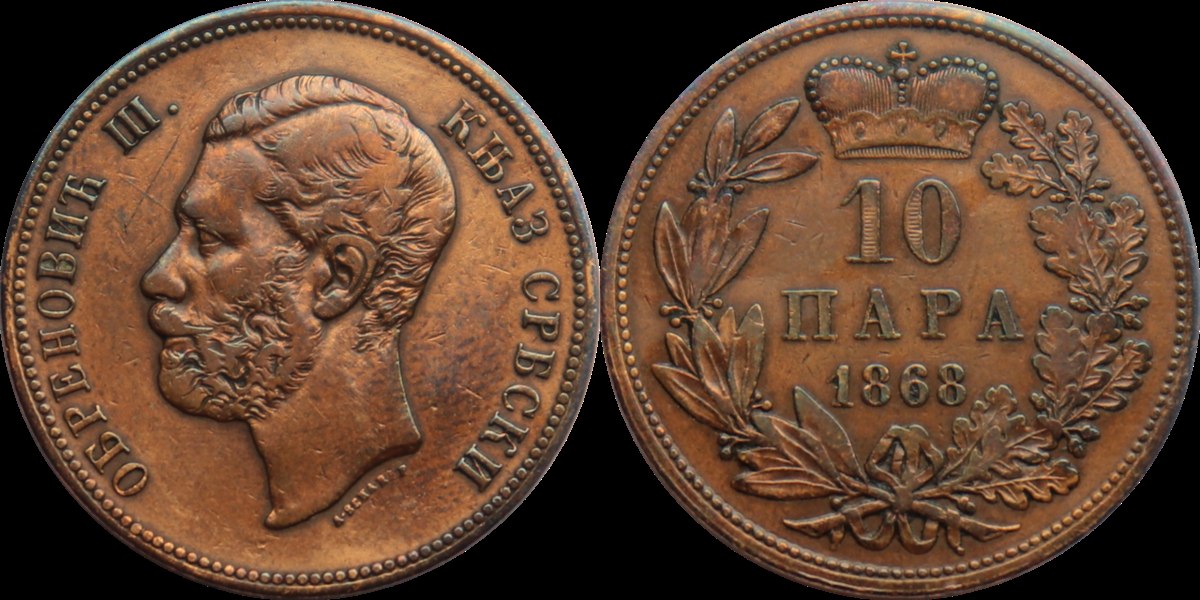

The 10-para coin combines the prince’s portrait with a clearly readable denomination and date. It helps distinguish the restoration of national coinage from the later definition of the silver dinar. Both belonged to the reconstruction of a monetary system, but they happened in different years.
04 / 12
1873–1882: the dinar returns by name
On 12 December 1873, the date commemorated by the National Bank, the Law on Minting the Serbian Silver Currency established the dinar as the principality’s official monetary unit. Silver coins followed in 1875. Three landmarks should therefore be kept distinct: copper in 1868, the legal definition in 1873 and the production of silver coinage in 1875. Collapsing them into a single date hides the gradual construction of the system.
Under Milan Obrenović, the new coins placed Serbia within a European monetary environment in which the franc and Latin Monetary Union standards provided influential models. Compatible specifications made it easier to compare coins. Technical alignment did not, however, make Serbia a formal treaty member of the union. Coin specifications and membership of an international agreement are different matters.
After international recognition of independence at the Congress of Berlin in 1878, a gold 20-dinar coin was issued in 1879. When Serbia became a kingdom in 1882, gold issues expressed Milan’s new royal status. Portrait, title and arms did more than identify an issuer: they presented an image of the state to everyone handling its coins.
Metal remained central, but it could no longer meet every need. Trade, credit and public finance required an institution able to issue paper and support a more flexible circulation. The next important change would be embodied in a printed promise rather than a new crown or royal likeness.
05 / 12
1884: learning to trust paper
Founded in 1884, the Privileged National Bank of the Kingdom of Serbia drew on the example of the National Bank of Belgium. It combined domestic private capital with government supervision. Its founding law had been ratified in 1883, while establishment and the start of operations belonged to the following year. This was not yet a publicly owned central bank of the modern kind.
The first Serbian banknote placed in circulation was a gold-payable 100 dinars of 1884. Its high denomination limited its usefulness for ordinary transactions. Trust in paper could not simply be proclaimed: people also needed denominations suited to their payments. Notes of 50 and 10 dinars followed in 1885; the silver-payable 10-dinar note became particularly important.
Research drawing on the bank’s archives and the mission of Belgian expert Charles Boschmans explains this practical difficulty. The challenge was not merely to persuade people accustomed to metal. Large notes were poorly suited to many purchases. Bringing banknotes into daily use required confidence, availability and denominations at the right scale.
“Payable in gold” or “payable in silver” did not mean that the paper itself contained precious metal. The wording referred to redemption commitments and the framework governing issue. Tensions between gold coin, silver coin and paper, investigated by monetary historians, prevent this period from being described as an uncomplicated, permanently fixed parity with foreign money.
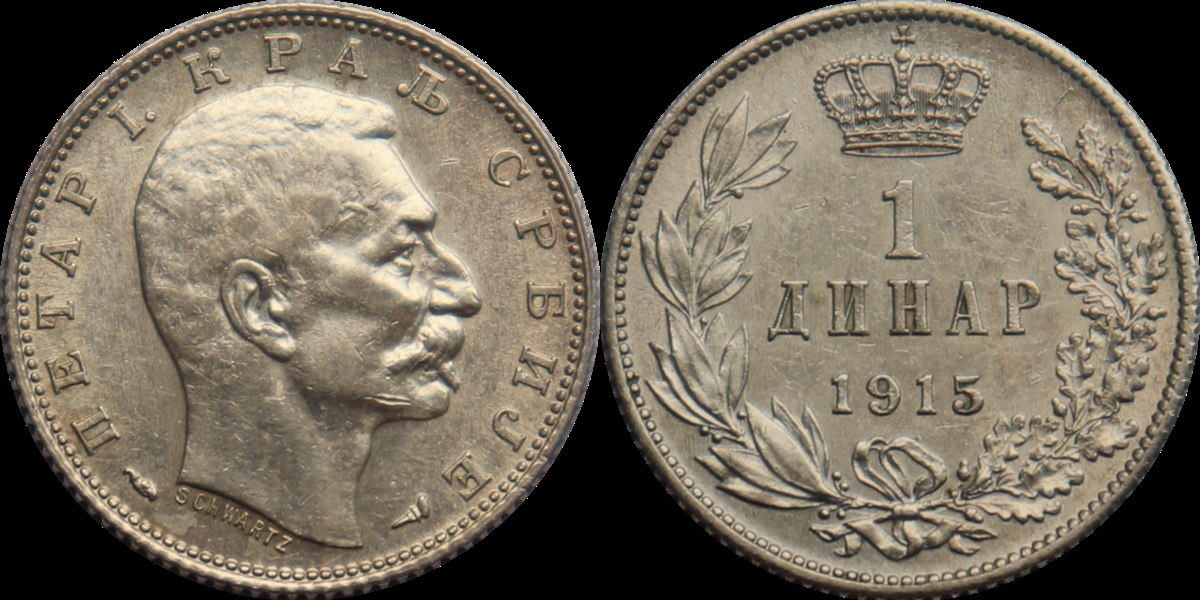

Dynastic changes also reached people through their coins. After the Obrenović rulers, issues of King Peter I Karađorđević carried a new portrait. The silver dinar of 1915 shown here preserves the monetary name while recording a different sovereign. The portrait communicates political authority; metal and denomination communicate monetary value.
06 / 12
1914–1931: a bank in exile and a shared dinar
The First World War put the kingdom’s institutions under extraordinary strain. The bank was evacuated in 1915 and eventually reached Marseille. There it continued activities including the exchange of Serbian dinars for French francs. Moving a bank meant more than transporting metal and archives: it meant preserving a means of payment when the administration and many citizens were far from home.
The Kingdom of Serbs, Croats and Slovenes was established in 1918. Bringing together territories formerly ruled by different states also required bringing their currencies together. The Austro-Hungarian crown and the dinar belonged to different accounting traditions. Dinar-crown banknotes made the transition tangible, displaying two values at a ratio of four crowns to one dinar.
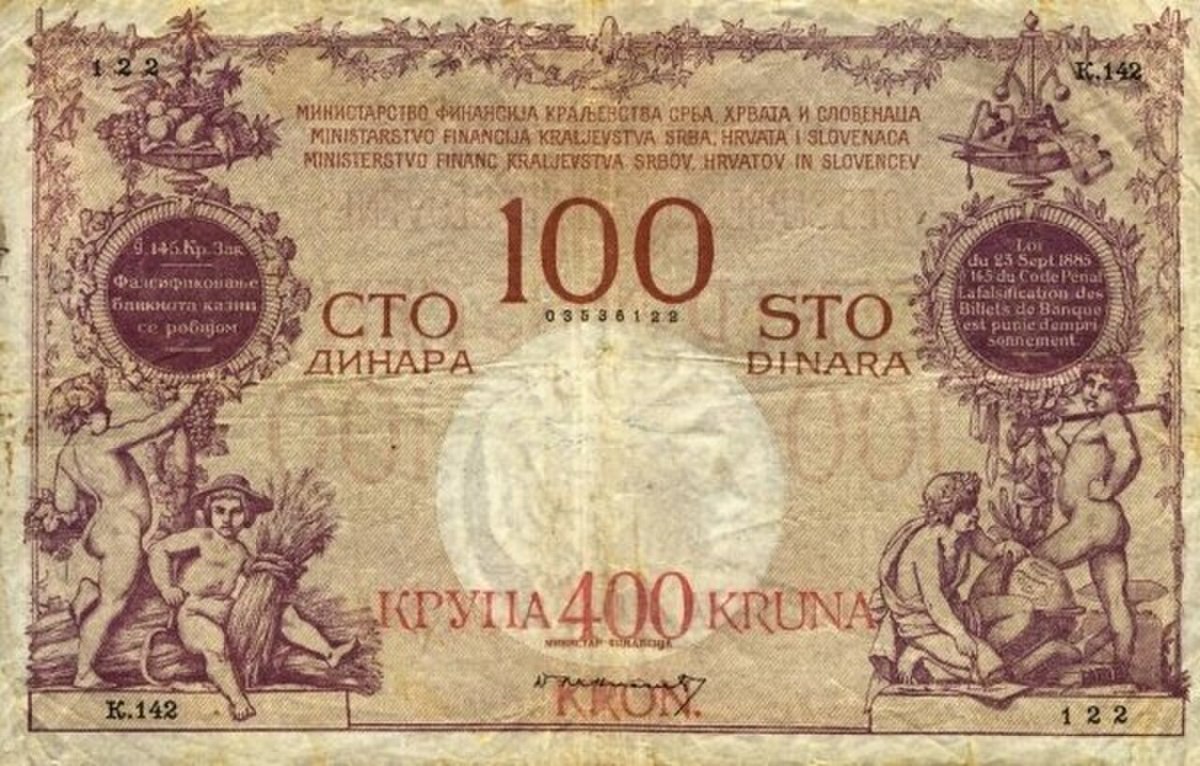

The illustrated issue dated 1919 therefore shows both 100 dinars and 400 crowns. The dual denomination helped people move between systems. It was an administrative conversion ratio, not a claim that every historical purchasing power was equivalent. When reading an old banknote, an overprint can be as significant as its main number.
In 1920, the former Serbian institution became the National Bank of the Kingdom of Serbs, Croats and Slovenes. The kingdom was renamed Yugoslavia in 1929. Its dinars were a shared currency. Describing them retrospectively as simply Serbian national banknotes would erase their political setting and wider public.
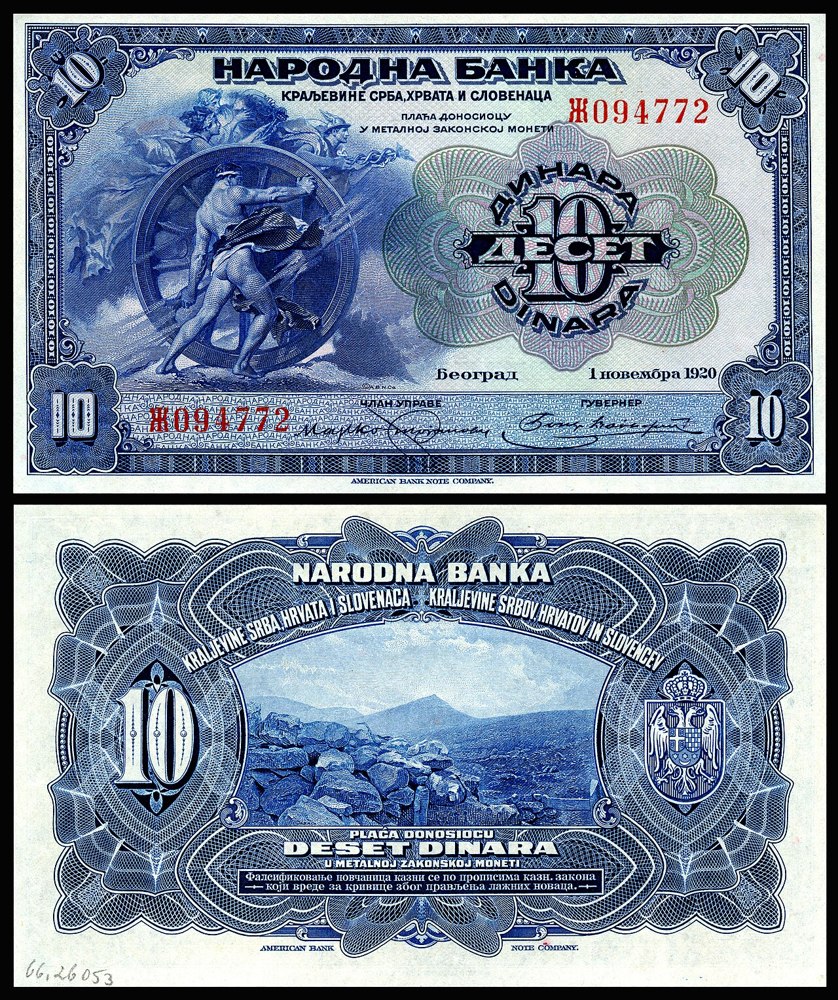

The stabilisation of the 1920s and the attempt to establish gold convertibility in 1931 belong to this shared history. International financial turmoil soon brought renewed restrictions. A legal declaration and the actual duration of a monetary arrangement must again be kept separate.
07 / 12
Topčider: making money in Belgrade
Early Serbian banknotes were printed abroad, notably in Belgium and France. Establishing a national production facility changed that dependence. Building work at Topčider in Belgrade began in 1927. The building was completed in 1929 and the printing works began operating that December, with domestic banknote production developing during the 1930s.
The undertaking brought together designers, engravers, printers, paper specialists, technicians and inspectors. A finely rendered portrait or a precisely repeated pattern contributed both to visual quality and to resistance to imitation. Currency production was applied art with an industrial requirement for exact repetition.
The coin-minting facility was built in 1937 and began producing coins in 1938. The opening of the printing works and the start of metal coin production are therefore different milestones. Establishing an institute did not mean that it immediately mastered every form of money.
Topčider remains central to the manufacture of National Bank of Serbia banknotes and coins. Its technical continuity crosses changes of name and political system. It offers a thread through this history beyond upheaval: skills handed down, machinery renewed and a lasting culture of precision.
08 / 12
1941–1966: occupation, reconstruction and a new scale
The invasion and partition of Yugoslavia in 1941 fragmented the monetary area once again. The kingdom’s bank continued in exile, while a Serbian National Bank was established in occupied Serbia. It replaced Yugoslav dinars with Serbian dinars within its issuing area. This occupation institution should not be presented as a straightforward revival of the nineteenth-century sovereign bank.
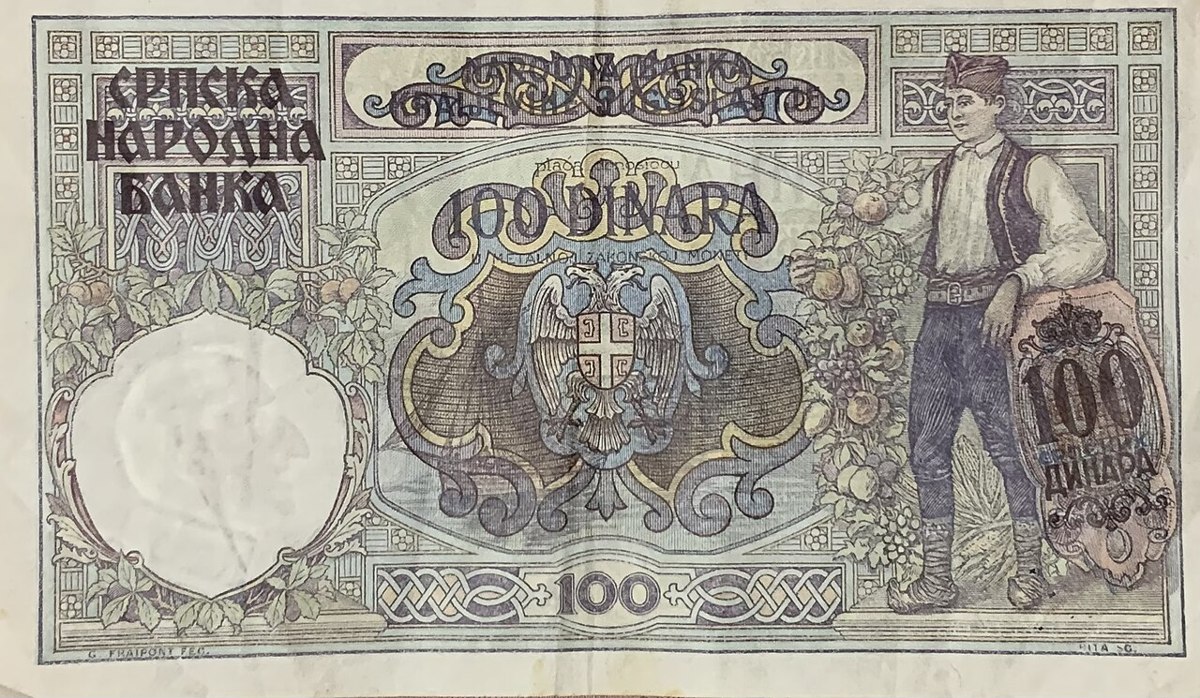

The 100-dinar note of 1941 shown here reused an earlier design with an issuer overprint. The technique made the change visible without requiring an entirely new banknote. Identifying such an object requires reading the overprint and understanding the setting rather than relying on the general appearance of its design.
After the war, the dinar became Yugoslav again within a socialist federation. The bank was nationalised in 1946. Work, farming and industry became important banknote subjects. Emblems and multilingual inscriptions expressed a collective project very different from the earlier language of royal portraits.
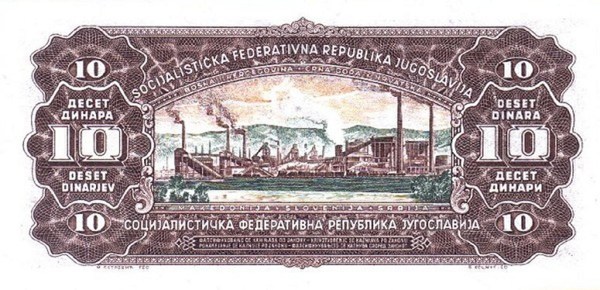

The reverse of the 10-dinar note dated 1965 shows an industrial landscape. It belongs to the generation accompanying the change of scale implemented on 1 January 1966: one new dinar equalled one hundred old dinars. A price of 1,000 old dinars became 10 new dinars. The change simplified amounts; it did not by itself increase what wages could buy.
A banknote may carry a date earlier than its release into circulation. Its printed date, actual issue date and the date of a monetary reform must therefore remain separate pieces of information.
09 / 12
When denominations reached billions · 1989–1994
Inflation accelerated in federal Yugoslavia in the late 1980s. An IMF study published in 1991 already examined the surge of late 1989 and the stabilisation programme launched that December. On 1 January 1990, one dinar replaced 10,000 previous dinars. This episode must be distinguished from the still more extreme hyperinflation of 1992–1994.
The disintegration of the state, wars, disrupted production and trade, international sanctions and monetary financing of deficits then combined. The dinar of the Federal Republic of Yugoslavia, consisting from 1992 of Serbia and Montenegro, lost its ability to preserve value. Political and economic causes reinforced one another; reducing the episode to a single explanation would be misleading.
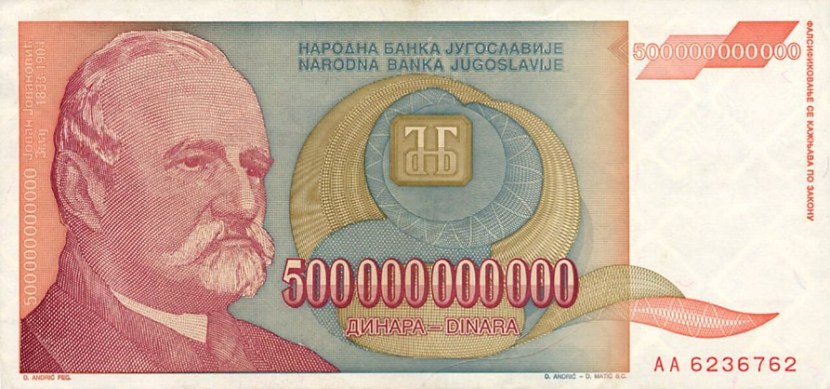

The 1993 note for 500 billion dinars carries the portrait of poet and physician Jovan Jovanović Zmaj. The dignity of the portrait remains while the number becomes almost unmanageable. The contrast shows how far a banknote’s visual quality and its economic worth can diverge. The zeros record an ordeal rather than extraordinary wealth.
When prices move at extreme speed, postponing a purchase can consume part of a person’s income. National currency becomes something people try to hold for as little time as possible, while the Deutsche Mark serves as a reference and store of value. The everyday effort to protect a wage or pension reveals more about this history than a league table of inflation records.
The programme associated with Dragoslav Avramović took effect on 24 January 1994 with the new dinar, initially anchored at parity to the Deutsche Mark. Stabilisation involved changing monetary and financial arrangements. Removing zeros without addressing the mechanisms that brought them back would not have been sufficient.
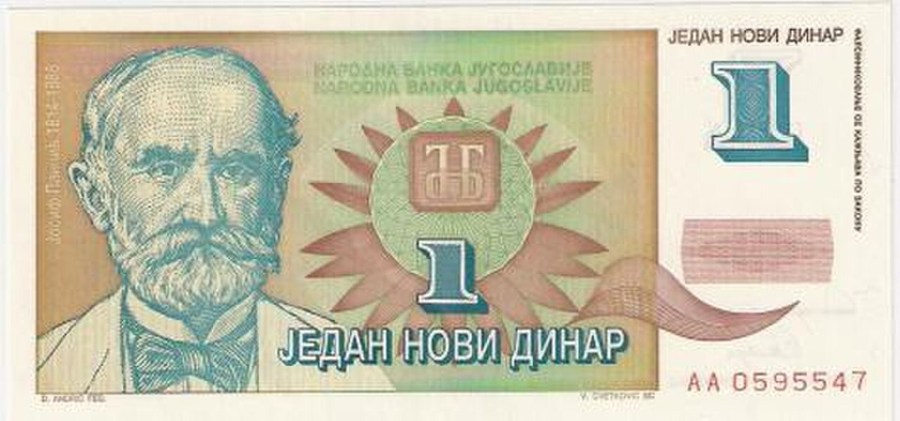

The return of a note denominated simply 1 captures the change visually. It did not restore savings already destroyed or immediately resolve the country’s difficulties, but it helped re-establish a usable scale of prices. Ending hyperinflation and rebuilding durable confidence were separate tasks.
10 / 12
2000–2006: a Serbian issuing name returns
A new Yugoslav banknote series was introduced between 2000 and 2002. It highlighted writers, scientists, artists and institutional figures. The 100-dinar note portraying Nikola Tesla reproduced below belongs to that series. Its issuer is the National Bank of Yugoslavia: it should not be captioned as a 2003 NBS note.
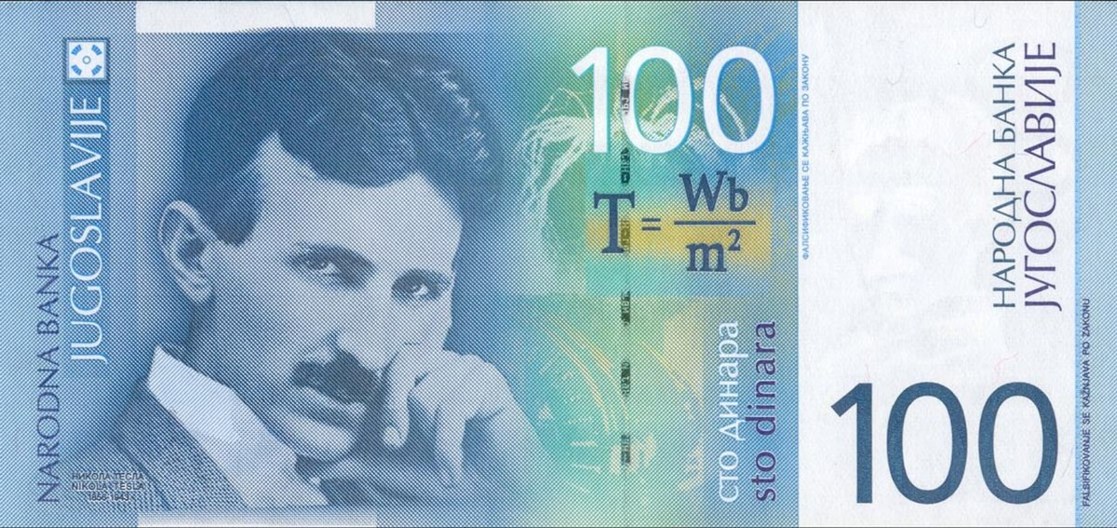

In 2003, when the State Union of Serbia and Montenegro was formed, the bank became the National Bank of Serbia. It issued money for circulation in the Republic of Serbia. The change of issuing name therefore preceded the end of the political union in 2006. New issues largely retained the previous visual language and later extended it, notably with the 500- and 2,000-dinar denominations.
The currency’s international code today is RSD. Its name remains dinar, but this does not turn medieval, royal, Yugoslav and contemporary dinars into a single unchanged unit. In a collection, issuer and date are essential to understanding what a repeated denomination means.
The institutional separation of Serbia and Montenegro also explains why the name of an earlier composite state cannot by itself define a modern monetary area. This account follows the Serbian dinar and its predecessors; it does not treat every Balkan currency called a dinar as RSD.
11 / 12
Banknotes: a library of faces
The contemporary series tells a story through knowledge and culture. A portrait is usually only the beginning: manuscripts, formulae, instruments, buildings and graphic compositions extend the biography on the reverse. Together the notes form a small library handled in everyday life.
| Dinars | Person | Cultural theme |
|---|---|---|
| 10 | Vuk Stefanović Karadžić | Language and writing |
| 20 | Petar II Petrović Njegoš | Poetry and thought |
| 50 | Stevan Stojanović Mokranjac | Music |
| 100 | Nikola Tesla | Electricity and invention |
| 200 | Nadežda Petrović | Painting and public service |
| 500 | Jovan Cvijić | Geography |
| 1 000 | Đorđe Vajfert | Industry and banking |
| 2 000 | Milutin Milanković | Mathematics and climate |
| 5 000 | Slobodan Jovanović | Law and history |
The 100-dinar note does more than honour Tesla: the formula for the unit of magnetic flux density incorporates science into the banknote’s design. The 2,000 dinars links Milutin Milanković to his work on climate cycles and representations of his calculations. The 200 dinars brings together Nadežda Petrović’s painting and her service as a volunteer nurse in the First Balkan War.
The 1,000 dinars returns to monetary institutions themselves. Industrialist and former governor Đorđe Vajfert appears with references to his brewery and to the bank’s interior. Njegoš, a figure in Montenegrin history and Serbian-language literature, recalls that cultural inheritances extend beyond present-day political borders.
Different sizes and colours, banknote paper, watermarks, security threads and other authentication features serve practical purposes. The portraits become familiar, while each note remains a carefully protected industrial object. For the faces of current issues, the NBS’s official descriptions are the reference; the historical images in this account are identified by their own issuer and date.
Denominations, portraits and motifs: [17]; list consulted on 15 October 2026.
12 / 12
Coins: heritage in the palm of a hand
The dinar is divided into one hundred para, but the NBS describes circulating coins in denominations of 1, 2, 5, 10 and 20 dinars. An accounting subdivision can survive after coins representing that fraction have ceased to play a role in everyday circulation. Coins have their own visual language; they are not merely banknotes made round.
Regular types draw on architecture: the bank building on the one-dinar coin, Gračanica Monastery on the 2 dinars, Krušedol Monastery on the 5 dinars, Studenica Monastery on a 10-dinar type and Saint Sava’s Church on a 20-dinar type. The designs bring a modern institution together with an older religious heritage. Different obverses, arms and dates nevertheless require each issue to be identified separately.
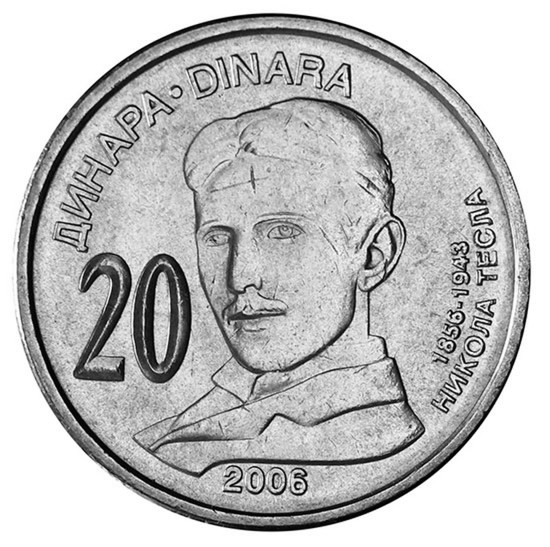

Commemorative motifs introduce another sense of time. The 2006 20-dinar coin marking the 150th anniversary of Tesla’s birth places a celebration on an object of payment. The reproduction here is black and white, one of the forms allowed under NBS reproduction rules. Its colour therefore does not represent the original metal.
Alongside circulating money, precious-metal numismatic issues address collectors and commemorate events, institutions and individuals. Face value alone tells us neither their purchase price nor their historical significance. The National Bank traces its Yugoslav-era commemorative issues back to 1968; contemporary Tesla series continue that practice.
From the silver of medieval mines to Topčider’s manufacturing processes, Serbian monetary history can be explored through materials as well as numbers. Reading a portrait, identifying an overprint, comparing issuers or recognising a building helps recover the events behind a familiar object.
FURTHER READING
Sources and credits
Numbered references accompany each chapter. Institutional sources and historical research consulted on 15 October 2026. Images are stored locally; only reference links require a connection.
- NBS — History of money in Serbia
- NBS Visitor Centre — Money in the Territory of Serbia
- British Museum — Stefan Uroš V, Cattaro, 1355–1371; 1898,1006.9
- NBS — 150 years of the Serbian dinar, 12 December 2023
- NBS — History of the National Bank of Serbia
- NBS / SEEMHN — Serbia/Yugoslavia: from 1884 to 1940 (2014), pp. 291–354
- S. Jerković & S. Ilić — Application of Latin Monetary Union Standards and Practice in Serbia (1868–1918), Bulgarian National Bank, 2022
- NBS — Balance sheet data of the National Bank 1920–1930, Research Bulletin, March 2022
- NBS — Zavod za izradu novčanica i kovanog novca – Topčider
- NBS — Cash operations
- NBS — Historical timeline (Corporate Social Responsibility Report 2013)
- Banka Slovenije — Zgodovina deviznih tečajev 1945–1998
- IMF — Yugoslav Inflation and Money, Working Paper 91/50 (1991)
- IMF — Federal Republic of Yugoslavia, Country Report 01/07 (2001), economic background
- NBS — Econometric analysis of money demand in Serbia
- NBS — Banknote series and portraits, 7 June 2016
- NBS — Banknotes in circulation
- NBS — Coins in circulation
- NBS — Decision on Conditions for the Reproduction of Banknotes and Coins, 18/2011
- NBS — Law on the National Bank of Serbia, art. 53–55
About the illustrations
Credits appear below each image. Free licences and public-domain designations supplied by collections are recorded in the image manifest. The 2006 coin is reproduced in black and white under the 2011 NBS decision; the other currency images are historical issues. The illustrated Tesla banknote is the 2000 issue, not a contemporary NBS issue.
Documentary reproductions; displayed proportions do not indicate the objects’ actual size.